
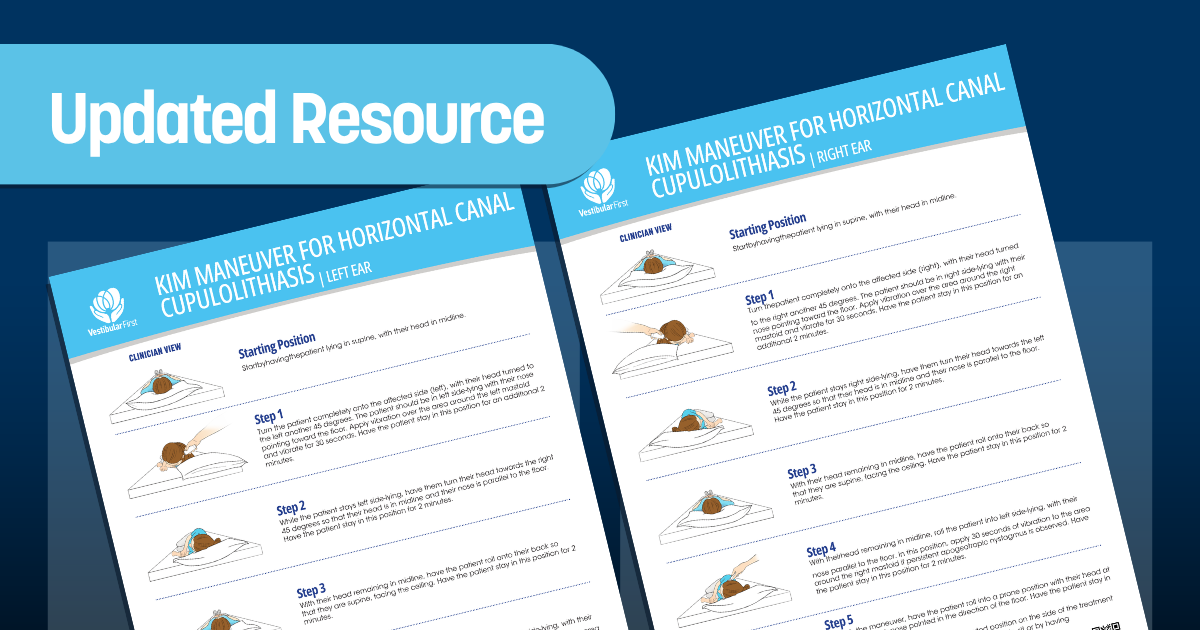
Handout for clinicians
Kim Maneuver for Horizontal Cupulolithiasis
Enhance your vestibular rehabilitation practice with our Kim Maneuver PDF guide, a concise, clinician-focused resource with clear, step-by-step instructions for safe and effective use. The Kim Maneuver is a canalith repositioning technique for horizontal cupulolithiasis BPPV, designed to reposition displaced otoconia, reduce vertigo, and improve balance, and can be incorporated when exam findings suggest horizontal canal involvement.
Download the Kim Maneuver PDF today.
For video instructions and more detailed information visit our treatment page on the Kim Maneuver for horizontal cupulolithiasis BPPV.
Step-by-Step Guide: Kim Maneuver for Horizontal Cupulolithiasis BPPV
Right Ear
- Explain the procedure to the patient and obtain consent.
- Start by having the patient lying in supine, with their head in midline.
- Turn the patient completely onto the affected side (right), with their head turned to the right another 45 degrees. The patient should be in right side-lying with their nose pointing toward the floor. Apply vibration over the area around the right mastoid and vibrate for 30 seconds. Have the patient stay in this position for an additional 2 minutes.
- While the patient stays right side-lying, have them turn their head towards the left 45 degrees so that their head is in midline and their nose is parallel to the floor. Have the patient stay in this position for 2 minutes.
- With their head remaining in midline, have the patient roll onto their back so that they are supine, facing the ceiling. Have the patient stay in this position for 2 minutes.
- With their head remaining in midline, roll the patient into left side-lying, with their
nose parallel to the floor. In this position, apply 30 seconds of vibration to the area
around the right mastoid if persistent apogeotropic nystagmus is observed. Have
the patient stay in this position for 2 minutes. - To finish the maneuver, have the patient roll into a prone position with their head at midline, with their nose pointed in the direction of the floor. Have the patient stay in this position for 2 minutes.
Left Ear
- Explain the procedure to the patient and obtain consent.
- Start by having the patient lying in supine, with their head in midline.
- Turn the patient completely onto the affected side (left), with their head turned to the left another 45 degrees. The patient should be in left side-lying with their nose pointing toward the floor. Apply vibration over the area around the left mastoid and vibrate for 30 seconds. Have the patient stay in this position for an additional 2 minutes.
- While the patient stays left side-lying, have them turn their head towards the right 45 degrees so that their head is in midline and their nose is parallel to the floor. Have the patient stay in this position for 2 minutes.
- With their head remaining in midline, have the patient roll onto their back so that they are supine, facing the ceiling. Have the patient stay in this position for 2 minutes.
- With their head remaining in midline, roll the patient into right side-lying, with their nose parallel to the floor. In this position, apply 30 seconds of vibration to the area around the left mastoid if persistent apogeotropic nystagmus is observed. Have the patient stay in this position for 2 minutes.
- To finish the maneuver, have the patient roll into a prone position with their head at midline, with their nose pointed in the direction of the floor. Have the patient stay in this position for 2 minutes.
It’s essential to perform the movements of the Kim Maneuver smoothly and to remain in each position for the recommended duration for the treatment to be effective.
For video instructions and more detailed information visit our treatment page on the Kim Maneuver for horizontal cupulolithiasis BPPV.