
Kurtzer Hybrid Maneuver
Description
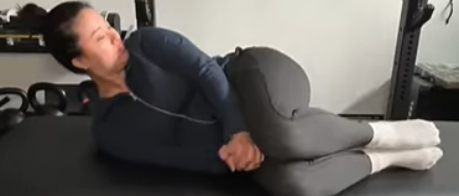
The Kurtzer Hybrid Maneuver is a treatment maneuver for horizontal canal BPPV. It was designed to treat horizontal canal variants without requiring the clinician to determine the affected side before starting treatment. The maneuver combines elements of the Appiani, Casani, and Gufoni maneuvers into one sequence, with the goal of treating both canalithiasis/geotropic and cupulolithiasis/apogeotropic presentations in a maximum of four positions.
Effectiveness
In the initial small case series of 9 patients with horizontal canal BPPV, the Kurtzer Hybrid Maneuver demonstrated an 89% resolution rate after a single treatment and 100% resolution after a second visit (Kurtzer, Gans, and McLeod, 2017). While these early findings are encouraging, the evidence base remains limited due to the small sample size and lack of larger independent studies specifically evaluating this maneuver.
History
The Kurtzer Hybrid Maneuver was first described in 2017 by Kurtzer, Gans, and McLeod from The American Institute of Balance. It remains a relatively niche horizontal canal BPPV maneuver.

Dr. Darren Kurtzer
Instructions
The purpose is to treat horizontal canal BPPV using a combined repositioning sequence that does not require clear identification of the affected side.
Step-by-Step Instructions
- Side-lying, nose up
Begin with the patient lying on one side with the nose positioned upward and the neck flexed about 30 degrees. The subjectively weaker side may be used first, but either side can be treated first. Hold for 1 minute after any nystagmus stops. -
Same side, nose down
Turn the patient’s head nose-down while maintaining about 30 degrees of neck flexion. Hold for 1 minute after nystagmus stops. -
Opposite side, nose up
Turn the head back to the nose-up position, then roll the patient’s body to the opposite side while keeping the head nose-up with about 30 degrees of neck flexion. If nystagmus occurs, hold for 1 minute after it stops. The authors recommend completing this position even if the patient appears clear. -
Opposite side, nose down
Turn the patient’s head nose-down while maintaining about 30 degrees of neck flexion. Hold for 1 minute after any nystagmus stops.
Optional re-check: Turn the patient’s head straight ahead, with no neck rotation, to confirm that vertigo and nystagmus are absent.
Related Pathology
Watch Related Journal Club
Sources
Kurtzer DA, Gans RE, McLeod H. New Horizontal Canal Benign Paroxysmal Positional Vertigo Treatment: Kurtzer Hybrid Maneuver. Glob J Otolaryngol. 2017;6(3):555686. doi:10.19080/GJO.2017.06.555686. https://juniperpublishers.com/gjo/GJO.MS.ID.555686.php