
Head Shaking Maneuver for Horizontal Cupulolithiasis
Description
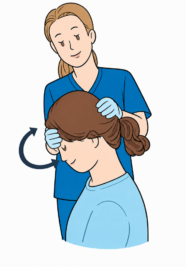
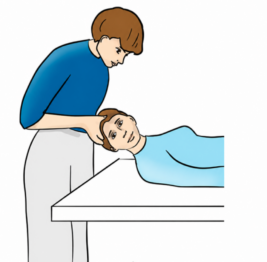
The therapeutic head-shaking maneuver is a treatment technique described for apogeotropic or horizontal cupulolithiasis BPPV. It consists of repeated horizontal head movements, most often with the head flexed forward about 30°. Some studies describe the maneuver in a sitting position, while others describe it with the patient lying supine to better align the lateral canal with the plane of rotation (Oh et al., 2009; Kim et al., 2012; Kong et al., 2020; Lee et al., 2023).

Effectiveness
Head shaking has not been shown to be superior to other treatments for horizontal cupulolithiasis BPPV. In the trial evaluating the seated version, success after up to two applications during the initial visit was 62.3% with head shaking versus 73.1% with the Gufoni maneuver; the difference was not statistically significant either immediately or during the 1-month follow-up (Kim et al., 2012).
In the trial evaluating the supine version, initial success was 18.2% with head shaking, 7.7% with the Gufoni–Appiani maneuver, and 33.3% with the cupulolith repositioning maneuver. Cumulative success at 4 weeks was 90.5%, 92.3%, and 100%, respectively, with no statistically significant difference in success rates among the groups at any assessment point (Lee et al., 2023). These longer-term outcomes followed repeated weekly treatment, with an additional geotropic maneuver performed when conversion occurred.
History
Instructions
The purpose is to loosen and mobilize otoconia so they can move out of a position that is provoking horizontal cupulolithiasis BPPV.
Seated Version
- Begin with the patient sitting upright.
- Flex the patient’s head forward about 30°.
- Hold the patient’s head securely.
- Shake the head side to side in a horizontal, sinusoidal motion at approximately 3 Hz for 15 seconds.
- Return the head to neutral.
- Second repetition can be applied if no resolution after 30 min after first repetition.
Supine Version
- Begin with the patient lying supine.
- Flex the patient’s head forward about 30°.
- Hold the patient’s head securely.
- Shake the head horizontally about 30° to each side at approximately 2 Hz for 15 seconds.
- Have the patient remain lying supine for 2 minutes.
Related Pathology
Sources
- Kim JS, Oh SY, Lee SH, et al. Randomized clinical trial for apogeotropic horizontal canal benign paroxysmal positional vertigo. Neurology. 2012;78(3):159-166. doi:10.1212/WNL.0b013e31823fcd26 https://pubmed.ncbi.nlm.nih.gov/22170885/
- Kong TH, Song MH, Kang JW, Shim DB. Double-blind randomized controlled trial on efficacy of cupulolith repositioning maneuver for treatment of apogeotropic horizontal canal benign paroxysmal positional vertigo. Acta Otolaryngol. 2020 Jun;140(6):473-478. doi: 10.1080/00016489.2020.1736339. Epub 2020 Mar 18. PMID: 32186237. https://pubmed.ncbi.nlm.nih.gov/32186237/
- Lee HJ, Jeon EJ, Nam S, Mun SK, Yoo SY, Bu SH, Choi JW, Chung JH, Hong SM, Lee SH, Kim MB, Koo JW, Kim HJ, Seo JH, Ahn SK, Park SN, Kim M, Chung WH. Treatment Efficacy of Various Maneuvers for Lateral Canal Benign Paroxysmal Positional Vertigo With Apogeotropic Nystagmus: A Randomized Controlled Trial. Clin Exp Otorhinolaryngol. 2023 Aug;16(3):251-258. doi: 10.21053/ceo.2023.00619. Epub 2023 Jul 26. PMID: 37499698; PMCID: PMC10471904. https://pmc.ncbi.nlm.nih.gov/articles/PMC10471904
- Oh SY, Kim JS, Jeong SH, Oh YM, Choi KD, Kim BK, Lee SH, Lee HS, Moon IS, Lee JJ. Treatment of apogeotropic benign positional vertigo: comparison of therapeutic head-shaking and modified Semont maneuver. J Neurol. 2009 Aug;256(8):1330-6. doi: 10.1007/s00415-009-5122-6. Epub 2009 Apr 12. PMID: 19363632. https://pubmed.ncbi.nlm.nih.gov/19363632/