
Farouk Praying Maneuver
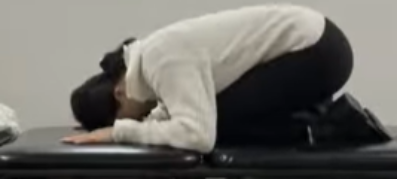
Description
The Farouk Praying Maneuver is a novel, clinician-performed maneuver concept for refractory or atypical posterior canal BPPV, including suspected debris in the following posterior canal locations:
- Ampullary segment of the long arm
- Short arm
- Cupulolithiasis — ampullary segment / long-arm side
- Cupulolithiasis — short-arm side
- Non-ampullary segment of the long arm
- Intermediate segment of the long arm — typical posterior canal BPPV
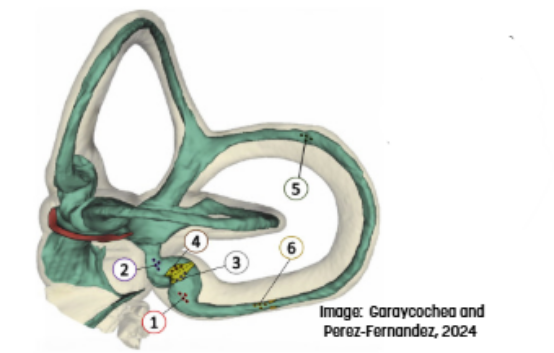
The maneuver uses a stable forward-bending prayer-like/sujood posture, with optional mastoid vibration and slow salutation-style head turns, to help detach or mobilize otoconia and direct debris toward the utricle. It should be performed by a trained clinician and is currently best framed as an emerging maneuver concept rather than a validated first-line treatment (Farouk, 2025).
Effectiveness
Direct effectiveness has not yet been established. Current support is limited to a preprint/educational description without a reported clinical cohort, success rate, or comparison group; the author notes that future comparative studies and randomized controlled trials are needed for validation (Farouk, 2025).
History
Dr. Mahmoud Farouk introduced the maneuver in a 2025 preprint as a novel alternative to Bascule-type treatment. The “praying” terminology comes from the sujood/prostration posture used for patient positioning, while the maneuver design was intended to create a more stable and clinically adaptable version of forward-bending posterior canal treatment.
Dr. Mahmoud Farouk
Instructions
To help mobilize or detach otoconia in refractory, atypical, or suspected posterior canal cupulolithiasis, with the proposed goal of moving debris toward the utricle when standard posterior canal maneuvers have not been effective.
- Confirm refractory posterior canal BPPV after limited response to standard repositioning maneuvers, such as Epley.
- Start with the patient seated upright.
- Move the patient into full prostration, or sujood/praying posture.
- Hold for about 30–60 seconds.
- Apply optional mastoid vibration to the affected ear. A continuous vibration device is preferred; a 128–256 Hz tuning fork or manual tapping may also be used.
- Slowly return the patient to upright sitting.
- Perform salutation-style head turns: first toward the affected side, then toward the opposite side.
- Repeat the sequence once, for a total of 2 prostrations with vibration.
- Supervise all posture transitions and provide knee support as needed.
Related Pathology
Sources
- Farouk M. Farouk Praying Maneuver: A Novel Alternative to the Bascule Maneuver for Refractory Posterior Canal BPPV. ResearchGate; 2025. doi:10.13140/RG.2.2.15403.50729 https://www.researchgate.net/publication/395099429_Farouk_Praying_Maneuver_A_Novel_Alternative_to_the_Bascule_Maneuver_for_Refractory_Posterior_Canal_BPPV
- Garaycochea O, Pérez-Fernández N. Variants of posterior semicircular canal involvement in benign paroxysmal positional vertigo. Acta Otorrinolaringol Esp (Engl Ed). 2024 Sep-Oct;75(5):324-334. doi: 10.1016/j.otoeng.2024.01.013. Epub 2024 Mar 2. PMID: 38438080. https://pubmed.ncbi.nlm.nih.gov/38438080/