
Horizontal Canalithiasis

Definition
Horizontal or lateral canalithiasis BPPV (Benign Paroxysmal Positional Vertigo) occurs when free-floating otoconia (tiny calcium carbonate crystals) have dislodged from the utricle and entered the horizontal semicircular canal. With head movements, gravity and inertia cause these particles to shift, generating endolymphatic flow that abnormally deflects the cupula. This leads to brief nystagmus and symptoms during positional testing.
In the horizontal canal, endolymph flow toward the ampulla (ampullopetal) is excitatory, while flow away from the ampulla (ampullofugal) is inhibitory, producing a geotropic (toward the ground) nystagmus pattern during the right and left supine roll tests. The stronger geotropic nystagmus typically identifies the affected ear for horizontal canalithiasis BPPV. Symptoms are brief and fatigable, as the otoconia settle after movement, stopping the abnormal stimulation.

Clinical Findings
-
In horizontal canal BPPV, nystagmus on BOTH sides of the supine roll test is observed, with two distinct presentations:
- Geotropic (more common): Nystagmus beats toward the ground, stronger on the affected side — suggests canalithiasis in the long arm of the horizontal canal.
- Apogeotropic (less common): Nystagmus beats away from the ground, often due to cupulolithiasis or debris near the ampulla.
-
Postural Instability, especially with eyes closed or head turns
-
Oculomotor Examination
-
Abnormal Head Impulse Test (HIT) – could be abnormal if BPPV started with concurrent acute unilateral vestibular hypofunction, otherwise typically negative
-
Spontaneous Nystagmus – could be present if BPPV is in a horizontal canal
-
An example of geotropic nystagmus, consistent with left horizontal canalithiasis BPPV
3 Easy Steps to find the affected side in HC BPPV
- Identify if the patient has horizontal canalithiasis (geotropic nystagmus) or horizontal cupulolithiasis (apogeotropic nystagmus) during the supine roll test
- An optional test to substitute for the supine roll test would be the upright head roll test (Malara et al., 2020), which can work in a complimentary way with other testing such as the Bow and Lean test described in Step 3.
- Utilize symptom and nystagmus strength as a strategy for identifying the affected side if possible
- For canalithiasis, during the supine roll test, the side where the patient’s head was turned when they have the STRONGER symptoms and nystagmus is usually the affected side
- For cupulolithiasis, during the supine roll test, the side where the patient’s head was turned when they have the WEAKER symptoms and nystagmus is usually the affected side.
- If needed, utilize the Bow and Lean (or Sit to/from Supine) test when Step 2 doesn’t clearly indicate a side with stronger symptoms
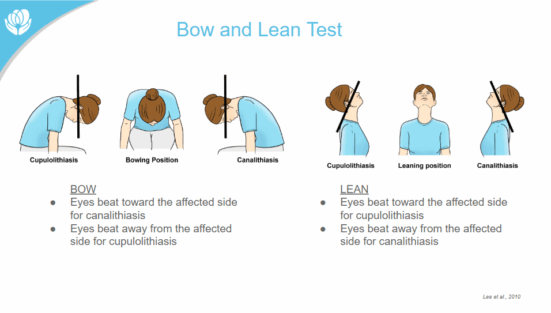
Tests
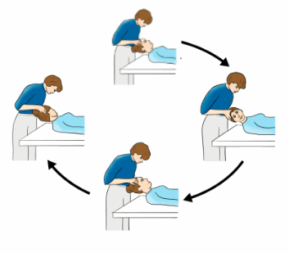
Treatment Maneuvers
- Barbecue (BBQ) roll
- Li Quick Roll for horizontal canalithiasis
- Gufoni for horizontal canalithiasis
- Kurtzer Hybrid
- Square wave maneuver
Patient Focused Treatment Handouts (PDFs)

Research Highlight- Order of testing could matter!
A 2022 study by Bhandari et al. used 3D simulations to show that the supine roll test (SRT) in horizontal canalithiasis is influenced by where otolith debris starts in the canal and the order in which the test is performed. Depending on whether the head is turned first to the affected or unaffected side, nystagmus can appear as bilateral direction-changing, bilateral direction-fixed, or unilateral, potentially leading to misdiagnosis of the involved side.
The simulations revealed that the SRT itself can reposition debris and resolve symptoms, explaining cases where no nystagmus appears during treatment. The authors recommend standardizing SRT by always starting from the right side to improve diagnostic consistency.
Want to learn more about BPPV? – Check out these resources
- Vestibular First: Online, Self-Paced CEU Courses for Clinicians. Course Bundles now available!
- Intro Courses
- Intermediate Courses
- Comprehensive list of Vestibular Education and Course Providers
- Vestibular Today Free Access Online BPPV Resources
- Balancing Act Rehabilitation: Understanding and Managing BPPV page
Sources
- Bhandari A, Bhandari R, Kingma H, Strupp M. Modified Interpretations of the Supine Roll Test in Horizontal Canal BPPV Based on Simulations: How the Initial Position of the Debris in the Canal and the Sequence of Testing Affects the Direction of the Nystagmus and the Diagnosis. Front Neurol. 2022 May 31;13:881156. doi: 10.3389/fneur.2022.881156. PMID: 35711266; PMCID: PMC9197467. https://pubmed.ncbi.nlm.nih.gov/35711266/
- Bhattacharyya, Neil, et al. “Clinical Practice Guideline: Benign Paroxysmal Positional Vertigo (Update).” Otolaryngology–Head and Neck Surgery, vol. 156, no. 3_suppl, 2017, pp. S1–S47. https://aao-hnsfjournals.onlinelibrary.wiley.com/doi/10.1177/0194599816689667
- Malara P, Castellucci A, Martellucci S. Upright head roll test: A new contribution for the diagnosis of lateral semicircular canal benign paroxysmal positional vertigo. Audiol Res. 2020 Jul 7;10(1):236. doi: 10.4081/audiores.2020.236. PMID: 32676175; PMCID: PMC7358984. https://pmc.ncbi.nlm.nih.gov/articles/PMC7358984/
- von Brevern M, Bertholon P, Brandt T, Fife T, Imai T, Nuti D, Newman-Toker D. Benign paroxysmal positional vertigo: Diagnostic criteria. J Vestib Res. 2015;25(3-4):105-17. doi: 10.3233/VES-150553. PMID: 26756126. https://pubmed.ncbi.nlm.nih.gov/26756126/