
Half Somersault (Foster)
Description
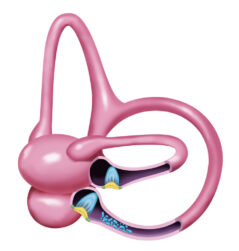
The half somersault maneuver, also called the Foster maneuver, is a self-treatment repositioning maneuver for posterior canalithiasis BPPV. It uses kneeling and head-position changes to help move loose otoconia out of the posterior semicircular canal.
Effectiveness
In the original randomized study, complete resolution of dizziness and nystagmus after two self-performed maneuvers occurred in 27% of the Foster maneuver group, compared with 37% of the self-Epley group. Later evidence suggests it may help improve residual dizziness and symptom scores, but it may require more repetitions than the Epley maneuver, and the overall evidence base remains limited (Khaftari et al., 2021; Alashram, 2025).
History
The treatment is named for Carol A. Foster, MD, an otolaryngologist/neurotologist whose clinical work focused on dizziness, vertigo, and balance disorders. Foster developed the maneuver after experiencing BPPV herself and looking for a way to reposition the crystals that was easier to perform independently. She and her colleagues introduced the half-somersault maneuver into clinical use in 2006, studied it from 2007 to 2010, and published the original randomized comparison with the self-Epley maneuver in 2012 (Foster et al., 2012).

Dr. Carol Foster
Instructions
The purpose is to provide a self-administered repositioning option for posterior canalithiasis BPPV by using gravity and sequential head positioning to guide free-floating otoconia out of the posterior canal and back toward the utricle.
Right
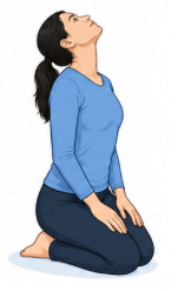
- Begin kneeling.
- Quickly tip the head upward and back.
- Move into a head-down half-somersault position, tucking the chin toward the knees.
- Turn the head about 45 degrees toward the right shoulder, so the face is directed toward the right elbow.
- Keeping the head turned 45 degrees to the right, raise the head to the level of the back/shoulders.
- Keeping the head turned 45 degrees to the right, continue rising to a fully upright kneeling position.
⏱️ After each position change, wait for dizziness to stop before moving on. If no dizziness occurs, hold the position for about 15 seconds.
Left
- Begin kneeling.
- Quickly tip the head upward and back.
- Move into a head-down half-somersault position, tucking the chin toward the knees.
- Turn the head about 45 degrees toward the left shoulder, so the face is directed toward the left elbow.
- Keeping the head turned 45 degrees to the left, raise the head to the level of the back/shoulders.
- Keeping the head turned 45 degrees to the left, continue rising to a fully upright kneeling position
⏱️ After each position change, wait for dizziness to stop before moving on. If no dizziness occurs, hold the position for about 15 seconds.