
Anterior Canalithiasis
Definition
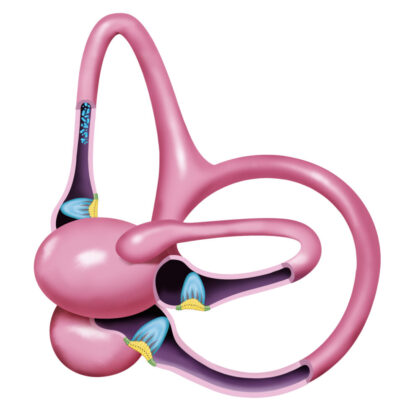
Anterior or superior canalithiasis BPPV (Benign Paroxysmal Positional Vertigo) is caused by free-floating otoconia (tiny calcium carbonate crystals) that have dislodged from the utricle and entered the anterior semicircular canal. These loose crystals move with head position changes, creating abnormal fluid flow that deflects the cupula and triggers brief episodes of vertigo/dizziness and downbeating, with or without torsional nystagmus, typically lasting less than 60 seconds.
Anterior canal BPPV is extremely rare at ~1% of cases (Bhandari et al., 2023), although others estimate 3-12% (Garaycochea et al., 2022). Because the anterior canal produces nystagmus patterns similar to those seen in cases of short arm posterior canal BPPV or central lesions, distinguishing this rare BPPV variant from cerebellar or brainstem pathology is essential.

Clinical Findings
- Brief (< 60 sec), downbeating nystagmus—sometimes accompanied by a subtle torsional component toward the affected ear, typically triggered by head-hanging positions.
-
Postural Instability, especially with eyes closed or head turns
-
Oculomotor Examination
-
Abnormal Head Impulse Test (HIT) – could be abnormal if BPPV started with concurrent acute unilateral vestibular hypofunction, otherwise typically negative
-
An example of nystagmus consistent with right anterior canalithiasis BPPV (right torsional downbeating lasting a few seconds)
Tests

Treatment Maneuvers
Patient Focused Treatment Handouts (PDFs)
Research Highlight

A recent 2025 3D simulation study by Arán-Tapia et. al, evaluated the biomechanics of otoconia displacement during the original vs. modified Yacovino maneuver for anterior canal BPPV. The original maneuver frequently resulted in ampullary entrapment of the otoconia and canal conversion, whereas the modified version (initiating in a prone position with 50° head flexion and incorporating optimized angular rotations and 30-second rest intervals) demonstrated more effective otoconia clearance.
Want to learn more about BPPV? – Check out these resources
Sources
- Anagnostou E, Kouzi I, Spengos K. Diagnosis and Treatment of Anterior-Canal Benign Paroxysmal Positional Vertigo: A Systematic Review. J Clin Neurol. 2015 Jul;11(3):262-7. doi: 10.3988/jcn.2015.11.3.262. Epub 2015 May 28. PMID: 26022461; PMCID: PMC4507381. https://pubmed.ncbi.nlm.nih.gov/26022461/
- Arán-Tapia I, Bastos G, P Muñuzuri A. Optimization of the Yacovino maneuver for superior canal BPPV using numerical simulations. Hear Res. 2025 Jul 22;466:109374. doi: 10.1016/j.heares.2025.109374. Epub ahead of print. PMID: 40712496. https://www.sciencedirect.com/science/article/pii/S0378595525001923
- Bertholon P, Bronstein AM, Davies RA, Rudge P, Thilo KV. Positional down beating nystagmus in 50 patients: cerebellar disorders and possible anterior semicircular canalithiasis. J Neurol Neurosurg Psychiatry. 2002 Mar;72(3):366-72. doi: 10.1136/jnnp.72.3.366. PMID: 11861698; PMCID: PMC1737794. https://pubmed.ncbi.nlm.nih.gov/11861698/
- Bhattacharyya, Neil, et al. “Clinical Practice Guideline: Benign Paroxysmal Positional Vertigo (Update).” Otolaryngology–Head and Neck Surgery, vol. 156, no. 3_suppl, 2017, pp. S1–S47. https://aao-hnsfjournals.onlinelibrary.wiley.com/doi/10.1177/0194599816689667
- Bhandari R, Bhandari A, Hsieh YH, Edlow J, Omron R. Prevalence of Horizontal Canal Variant in 3,975 Patients With Benign Paroxysmal Positional Vertigo: A Cross-sectional Study. Neurol Clin Pract. 2023 Oct;13(5):e200191. doi: 10.1212/CPJ.0000000000200191. Epub 2023 Aug 23. PMID: 37664131; PMCID: PMC10473829. https://pubmed.ncbi.nlm.nih.gov/37664131/
- Califano L, Salafia F, Mazzone S, Melillo MG, Califano M. Anterior canal BPPV and apogeotropic posterior canal BPPV: two rare forms of vertical canalolithiasis. Acta Otorhinolaryngol Ital. 2014 Jun;34(3):189-97. PMID: 24882928; PMCID: PMC4035840. https://pubmed.ncbi.nlm.nih.gov/24882928/
-
Garaycochea O, Pérez-Fernández N, Manrique-Huarte R. A novel maneuver for diagnosis and treatment of torsional-vertical down beating positioning nystagmus: anterior canal and apogeotropic posterior canal BPPV. Braz J Otorhinolaryngol. 2022 Sep-Oct;88(5):708-716. doi: 10.1016/j.bjorl.2020.09.009. Epub 2020 Oct 28. PMID: 33176986; PMCID: PMC9483926. https://pubmed.ncbi.nlm.nih.gov/33176986/