
Bow and Yaw Maneuver
Description
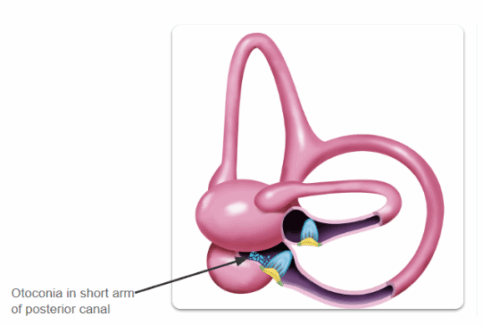
The bow-and-yaw maneuver is designed to treat short-arm posterior canal BPPV. It involves a deep forward bow of the head with side-to-side rotations to facilitate movement of otoconia from the short arm of the canal into the utricle. Studies have shown it can resolve cases that do not respond to standard repositioning maneuvers or can convert cases of short arm posterior canal BPPV to long arm posterior canal BPPV, which could then be treated with a standard modified Epley maneuver.
Effectiveness
In a prospective series of 171 PSC-BPPV patients, the bow-and-yaw maneuver alone resolved symptoms in ~40% (68/171), consistent with short-arm canalithiasis (Ping et al., 2022). A 2023 case report further demonstrated that bow-and-yaw followed by the Epley maneuver eliminated atypical posterior canal BPPV after standard maneuvers had failed (Ludwig & Schubert, 2023).
History
The bow-and-yaw maneuver originated from Oas’s 2001 proposal that otoconia could lodge in the short arm of the posterior canal, requiring a different approach to treatment. Researchers from 2017–2019 developed the maneuver using 3D modeling and clinical studies, demonstrating its ability to reposition otoconia from the short arm back into the utricle. More recently, case reports (e.g., Ludwig & Schubert, 2023) have confirmed its effectiveness in treating atypical posterior canal BPPV.
Instructions
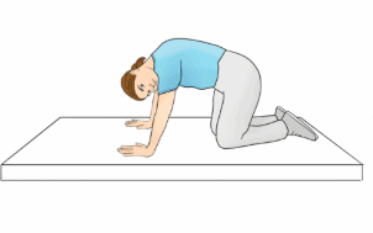
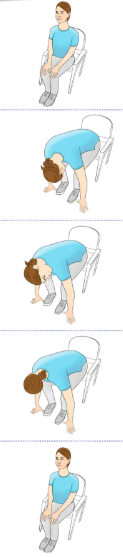
The purpose of the maneuver is to reposition otoconia from the short arm of the posterior canal back into the utricle using deep head flexion (“bow”) and horizontal head rotations (“yaw”). This maneuver can be performed in sitting or quadruped.
Seated
- Explain the procedure to the patient and obtain consent.
- Start seated in a chair with legs firmly planted on the ground.
- Have the patient bend down with their head towards their feet and the top of their head towards the floor.
- Then have the patient rotate their head 45 deg to the right.
- Then have the patient rotate their head 45 degrees right and left without pausing in the middle. Perform 10 full rotations (left and right rotation is 1 full rotation).
- Have the patient slowly sit up in the chair with neutral head position.
Quadruped
- Explain the procedure to the patient and obtain consent.
- Start in a quadruped position on a low mat table, bed or floor.
- Have the patient bend their head down toward the support surface so that they are in 135 degrees of forward head flexion.
- Then have the patient rotate their head 45 degrees right and left without pausing in the middle. Perform 10 full rotations (left and right rotation is 1 full rotation).
- Slowly bring the head back to midline and go
into a side-sitting position. Carefully come to
sitting with head center and erect.
Seated
Quadruped

Related Pathology
Sources
- Ping L, Yi-Fei Z, Shu-Zhi W, Yan-Yan Z, Xiao-Kai Y. Diagnosis and treatment of the short-arm type posterior semicircular canal BPPV. Braz J Otorhinolaryngol. 2022 Sep-Oct;88(5):733-739. doi: 10.1016/j.bjorl.2020.10.012. Epub 2020 Nov 23. PMID: 33303414; PMCID: PMC9483947. https://www.sciencedirect.com/science/article/pii/S1808869420302020?via%3Dihub
- Ludwig D, Schubert MC. Resolution of atypical posterior semicircular canal BPPV: evidence for putative short-arm location. BMJ Case Rep. 2023 May 29;16(5):e254579. doi: 10.1136/bcr-2023-254579. PMID: 37247949; PMCID: PMC10230912. https://pubmed.ncbi.nlm.nih.gov/37247949/