
Posterior Canalithiasis BPPV
Definition
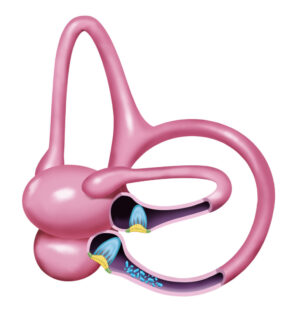
Posterior canalithiasis BPPV (Benign Paroxysmal Positional Vertigo) is caused by free-floating otoconia (tiny calcium carbonate crystals) that have dislodged from the utricle and entered the posterior semicircular canal. These loose crystals move with head position changes, creating abnormal fluid flow that deflects the cupula and triggers brief episodes of vertigo/dizziness and up-beating, torsional nystagmus, typically lasting less than 60 seconds.

Diagnostic Criteria – Bárány Society
- Recurrent attacks of positional vertigo or positional dizziness provoked by lying down or turning over in the supine position.
- Duration of attacks < 1 min
- Positional nystagmus elicited after a latency of one or few seconds by the Dix-Hallpike test or side-lying test. The nystagmus is a combination of torsional nystagmus with the upper pole of the eyes beating toward the lower ear combined with vertical nystagmus beating upward (toward the forehead) typically lasting < 1 minute
- Not attributable to another disorder.
Nystagmus consistent with right posterior canalithiasis BPPV (right torsional upbeating lasting ~10 sec)
Clinical Findings
- Brief latency followed by upbeating, torsional, nystagmus (torsion toward the affected ear) lasting < 1 min during positional testing
-
Postural Instability, especially with eyes closed or head turns
-
Oculomotor Examination
-
Abnormal Head Impulse Test (HIT) – could be abnormal if BPPV started with concurrent acute unilateral vestibular hypofunction, otherwise typically negative
-
Tests

Treatment Maneuvers
Patient Focused Treatment Handouts (PDFs)
Research Highlight

In patients with posterior canalithiasis BPPV, adding mastoid vibration during the canalith repositioning (Epley) maneuver does not significantly improve symptom resolution or reduce recurrence rates (Hain et al., 2000), (Macias et al., 2004).
Want to learn more about BPPV? – Check out these resources
- Vestibular First Courses
- Intro Courses
- Intermediate Courses
- Clinical Guide to BPPV Diagnosis and Treatment
- Comprehensive list of Vestibular Education and Course Providers
- Patient Education Resources:
Sources
- Bhattacharyya, Neil, et al. “Clinical Practice Guideline: Benign Paroxysmal Positional Vertigo (Update).” Otolaryngology–Head and Neck Surgery, vol. 156, no. 3_suppl, 2017, pp. S1–S47. https://aao-hnsfjournals.onlinelibrary.wiley.com/doi/10.1177/0194599816689667
- Hain TC, Helminski JO, Reis IL, Uddin MK. Vibration does not improve results of the canalith repositioning procedure. Arch Otolaryngol Head Neck Surg. 2000 May;126(5):617-22. doi: 10.1001/archotol.126.5.617. PMID: 10807329. https://pubmed.ncbi.nlm.nih.gov/10807329/
- Macias JD, Ellensohn A, Massingale S, Gerkin R. Vibration with the canalith repositioning maneuver: a prospective randomized study to determine efficacy. Laryngoscope. 2004 Jun;114(6):1011-4. doi: 10.1097/00005537-200406000-00010. PMID: 15179204. https://pubmed.ncbi.nlm.nih.gov/15179204/
- von Brevern M, Bertholon P, Brandt T, Fife T, Imai T, Nuti D, Newman-Toker D. Benign paroxysmal positional vertigo: Diagnostic criteria. J Vestib Res. 2015;25(3-4):105-17. doi: 10.3233/VES-150553. PMID: 26756126. https://pubmed.ncbi.nlm.nih.gov/26756126/