
Brandt-Daroff
Description
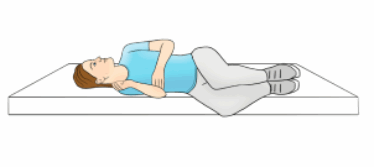
The Brandt-Daroff exercises are a set of positional habituation movements used in the management of benign paroxysmal positional vertigo (BPPV), particularly when standard canalith repositioning maneuvers are not possible. They involve repeatedly moving from sitting to a side-lying position with the head turned about 45° in the opposite direction, holding until vertigo subsides, then returning upright and repeating on the other side.
By provoking and then reducing dizziness through repetition, the exercises promote both habituation of vestibular responses and, in some cases, gradual relocation of displaced otoconia. Although less efficient than maneuvers like Epley or Semont, they remain as an option. The exercises are typically performed in multiple repetitions and sets over the course of a day and can be carried out independently at home.
Effectiveness
Research on the Brandt-Daroff exercises shows that while they can reduce symptoms of BPPV, the effectiveness is generally lower and slower compared with other maneuvers. A randomized trial found that the Brandt-Daroff achieved complete symptom resolution by three weeks, with similar long-term recurrence rates to the Epley maneuver, though improvement occurred more quickly with Epley in the first two weeks (Cetin et al., 2018).
Another RCT comparing Brandt-Daroff, Epley, Semont, and sham showed low resolution rates with Brandt-Daroff (22% initially, 16.7% at follow-up) and modest disability improvement, while Epley consistently outperformed all other groups (Celis-Aguilar et al., 2022).
A recent systematic review of 10 trials (880 participants) concluded that the Brandt-Daroff exercises did not significantly reduce symptoms or promote recovery compared with repositioning maneuvers (Alashram, 2024).
History
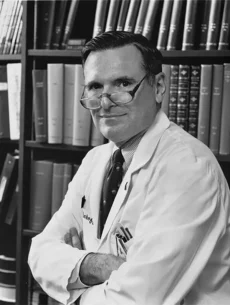
Dr. Robert Daroff
In 1980, German neurologist Thomas Brandt and American neuro-ophthalmologist Robert B. Daroff collaborated on a new treatment for BPPV. At that time, BPPV was thought to result from debris attached to the cupula of the semicircular canal (the “cupulolithiasis” theory). Brandt and Daroff developed a sequence of repeated side-lying movements as a therapeutic approach, reasoning that systematic exposure to the provoking positions could reduce symptoms.
In their original report, they documented improvement in the majority of patients after performing the exercises several times a day over a period of about a week. This represented one of the earliest structured, at-home treatment methods for BPPV, and it has remained in clinical use as a simple option when other repositioning maneuvers are not feasible.
Instructions
The purpose of the Brandt-Daroff exercises are both symptom reduction through habituation and, in some cases, facilitation of otoconia relocation for certain BPPV patients.
- Explain the procedure to the patient and obtain consent.
- Start seated on the edge of a mat table or bed
- Turn the head to the left.
- While keeping the head turned, lie down on the right side with legs on the bed/table. Remain in this position until symptoms subside, plus 30 seconds, up to 2 minutes maximum.
- Drop the legs off the bed/table and return to a sitting position, putting the head back in midline. Remain in this position until symptoms subside, plus 30 seconds, up to 2 minutes maximum.
- Turn the head to the right.
- While keeping the head turned, lie down to the left side with the legs on the bed/table. Remain in this position until symptoms subside, plus 30 seconds, up to 2 minutes maximum.
- Drop the legs off the bed and return to a sitting position, putting the head back in midline. Remain in this position until symptoms subside, plus 30 seconds, up to 2 minutes maximum.
Patient Focused Handouts (PDFs)
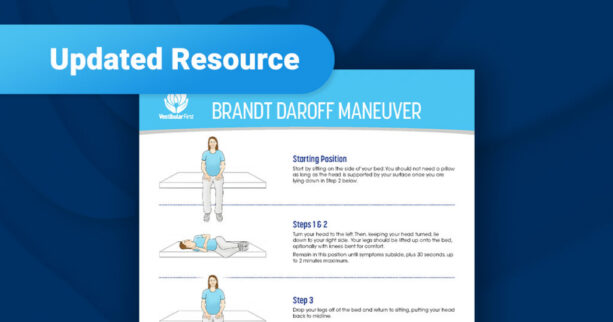
Looking for a patient-friendly handout for at-home treatment? We created a free printable resource you can give to your patients. Download it today!
Related Pathology
Sources
- Alashram AR. Effectiveness of brandt-daroff exercises in the treatment of benign paroxysmal positional vertigo: a systematic review of randomized controlled trials. Eur Arch Otorhinolaryngol. 2024 Jul;281(7):3371-3384. doi: 10.1007/s00405-024-08502-6. Epub 2024 Feb 11. PMID: 38341824. https://pubmed.ncbi.nlm.nih.gov/38341824/
- Bhattacharyya N, Gubbels SP, Schwartz SR, Edlow JA, El-Kashlan H, Fife T, Holmberg JM, Mahoney K, Hollingsworth DB, Roberts R, Seidman MD, Steiner RW, Do BT, Voelker CC, Waguespack RW, Corrigan MD. Clinical Practice Guideline: Benign Paroxysmal Positional Vertigo (Update). Otolaryngol Head Neck Surg. 2017 Mar;156(3_suppl):S1-S47. doi: 10.1177/0194599816689667. PMID: 28248609. https://pubmed.ncbi.nlm.nih.gov/28248609/
- Brandt T, Daroff RB. Physical therapy for benign paroxysmal positional vertigo. Arch Otolaryngol. 1980 Aug;106(8):484-5. doi: 10.1001/archotol.1980.00790320036009. PMID: 7396795. https://pubmed.ncbi.nlm.nih.gov/7396795/
- Celis-Aguilar E, Mayoral-Flores HO, Torrontegui-Zazueta LA, Medina-Cabrera CA, León-Leyva IC, Dehesa-López E. Effectiveness of Brandt Daroff, Semont and Epley maneuvers in the treatment of Benign Paroxysmal Positional Vertigo: A Randomized Controlled Clinical Trial. Indian J Otolaryngol Head Neck Surg. 2022 Sep;74(3):314-321. doi: 10.1007/s12070-021-02516-w. Epub 2021 Mar 23. PMID: 36213465; PMCID: PMC9535051. https://pubmed.ncbi.nlm.nih.gov/36213465/
- Cetin YS, Ozmen OA, Demir UL, Kasapoglu F, Basut O, Coskun H. Comparison of the effectiveness of Brandt-Daroff Vestibular training and Epley Canalith repositioning maneuver in benign Paroxysmal positional vertigo long term result: A randomized prospective clinical trial. Pak J Med Sci. 2018 May-Jun;34(3):558-563. doi: 10.12669/pjms.343.14786. PMID: 30034415; PMCID: PMC6041543. https://pubmed.ncbi.nlm.nih.gov/38341824/