
Tests You Can Do With Infrared Video Goggles
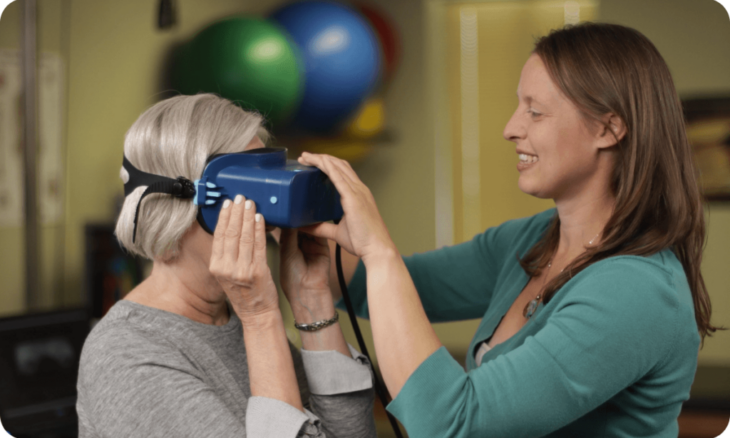
Per research, approximately two-thirds of abnormal eye movements in patients with vestibular disorders are missed when clinicians rely solely on room light observation or traditional thickened Frenzel lenses.
Since symptoms (or lack of symptoms such as vertigo) are not a consistent guide to diagnosis, it is essential to gather as much objective information as possible on exam.
The tests on this page include vestibular and oculomotor assessment elements that are best conducted using infrared video goggles (visual fixation removed or in the dark testing). Although some patients need only some instead of all of these tests, clinicians would benefit from knowing how to perform each test, which patients are appropriate for a given test, and characteristic normal and abnormal findings.
*Note: All nystagmus should be named with respect to the direction of the patient (example: a right beating nystagmus means the faster eye movement is pulling in the direction of the patient’s right side of their body). Videos show as if the clinician is facing the patient (example: clinician’s left is the patient’s right).
Ready to elevate your vestibular practice?
Get the quality, affordable infrared video goggles (video Frenzels) you deserve — visit v1st.co/store to purchase today.
Want to learn more first? Schedule a demo (on-demand or live remote), and see what you’ve been missing!
Spontaneous Nystagmus
Description:
Spontaneous nystagmus refers to involuntary rhythmic eye movements observed at rest (without any head movement, voluntary eye movement, or positional change). Depending on the root cause and acuity of the issue causing the spontaneous nystagmus, this type of nystagmus may not be visible unless visual fixation is removed via infrared video goggles.
A normal finding is no nystagmus.
This test is appropriate for most patients unless other emergent testing/treatment takes priority or if the patient is unable to open their eyes.
How to perform test:
Features of abnormal findings:
Vertical spontaneous nystagmus, such as persistent upbeating or downbeating nystagmus, is usually considered a central (brain issue such as stroke, multiple sclerosis, vestibular migraine, etc.) finding. In contrast, horizontal spontaneous nystagmus (with a fast phase either consistently beating or “direction-fixed” left or right) is most commonly associated with peripheral vestibular disorders, such as acute unilateral vestibulopathy (hypofunction or loss) or an uneven (one side damaged more than the other) bilateral vestibulopathy. The eyes will most often beat horizontally toward the more neurally active or “stronger” (non-damaged or less damaged) side.
Note that occasionally, central lesions can also cause a horizontal spontaneous nystagmus, but there are usually other findings such as abnormal saccades indicating that a brain issue is involved.
Example of an abnormal downbeating spontaneous nystagmus, consistent with a likely central pathology (in this case, the patient had a known prior cerebellar stroke):
Example of spontaneous right horizontal beat nystagmus consistent with a possible left peripheral vestibulopathy:
Gaze-Evoked Nystagmus
Description:
Gaze-evoked nystagmus is a type of nystagmus that occurs when a person attempts to gaze slightly (about 30 degrees from midline) up, down, left, or right (off-center). The clinician should instruct the patient to look slightly up, down, left, or right (not to end-range), holding each position for 5-10 seconds. Patients can have normal far end-range physiologic nystagmus to the left and right that is a mild and can occur when the eyes are held at extreme lateral gaze (well beyond 30° from midline).
A normal finding is no nystagmus, other than physiologic far left and right (end of eye movement range) end-gaze nystagmus which is a normal finding if seen.
This test is appropriate for most patients unless other emergent testing/treatment takes priority or if the patient is unable to open their eyes.
How to perform test:
Features of abnormal findings:
The presence of unidirectional gaze-evoked nystagmus—where the fast beat of the nystagmus remains in the same direction regardless of gaze position—is typically associated with peripheral vestibular disorders.
It may be present with a recent unilateral vestibulopathy or with recent bilateral vestibulopathy where the damage is incomplete (both sides are damaged, but one side is stronger than the other).
The intensity of gaze-evoked nystagmus can also be classified using Alexander’s Law, which describes how the amplitude of a nystagmus changes with gaze direction:
- First-degree nystagmus: fast beat nystagmus when the patient gazes toward the more neurally active (typically the “good” or undamaged) side, but not in primary gaze or when gazing away from the neurally active side; example: gaze right results in a right horizontal beat in a patient with a recent left peripheral vestibulopathy (left side is weaker than the right)
-
Second-degree nystagmus: fast beat nystagmus seen when the patient looks straight ahead (primary gaze) and when they look toward the healthy side, again with the fast beat consistently toward the more neurally active side
-
Third-degree nystagmus: fast beat nystagmus always toward the same side (example: right beating with a left peripheral vestibulopathy) seen with primary and lateral gaze in either direction, strongest when gazing toward the direction of the fast beat and weaker when gazing in the direction of the neurally less active (typically the “bad” or damaged) side
Direction-changing gaze-evoked nystagmus (left beat when gazing left, right beat when gazing right, and possibly upbeat when gazing up or downbeat when gazing down) is a sign of likely central pathology.
Example of 2nd degree left beating nystagmus, consistent with a possible right peripheral vestibulopathy:
Horizontal Head Shake Test
Description:
This test may detect peripheral vestibular asymmetry in the absence of spontaneous nystagmus. With the head tilted 30° forward, the clinician oscillates it side-to-side (2 Hz speed) for 20 seconds while fixation is removed by infrared video goggles.
A normal finding is 3 beats of horizontal nystagmus or less (often no nystagmus is present).
This test is appropriate for most patients unless other emergent testing/treatment takes priority, cervical issues do not allow the movement, the patient is unable to open their eyes, or they too nauseous or anxious to tolerate the test.
How to perform test:
Features of abnormal findings:
The head-shake test is abnormal if more than three beats of nystagmus are observed after shaking; horizontal nystagmus typically indicates a peripheral lesion (beating toward the non-lesioned or “stronger” side), while vertical nystagmus (if present/provoked by the test) suggests a central lesion.
Example of a horizontal head shake test with >3 beats of left beating nystagmus, consistent with possible recent right vestibulopathy:
Eye Alignment in the Dark
Description:
This test assesses ocular alignment in the absence of visual fixation to help identify ocular deviations such as exophoria (one eye deviates laterally when not getting visual input), which are often more noticeable following concussion. Using infrared video goggles, the patient is observed in complete darkness to remove fixation cues that normally can help to maintain eye alignment.
A normal finding in forward (primary) gaze is eyes that are aligned evenly, both vertically and horizontally.
This test is appropriate for most patients unless other emergent testing/treatment takes priority or if the patient is unable to open their eyes.
How to perform test:
Features of abnormal findings:
Example of abnormal eye alignment without visual fixation:
Pupillary Response to Visual Fixation
Description:
This test evaluates how the pupils respond to the presence or absence of visual fixation using infrared video goggles. In total darkness, the clinician observes baseline pupil size, then the clinician turns on the fixation lights to observe pupillary response to the introduction of light.
A normal finding is larger, open pupils in the dark, and a quick and equal response of small, constricted pupils when the visual fixation lights are turned on.
This test is appropriate for most patients unless other emergent testing/treatment takes priority or if the patient is unable to open their eyes.
How to perform test:
Features of abnormal findings:
If fixation triggers a slow, reduced, or unequal pupillary response, this may suggest central involvement and may warrant further neurological assessment and/or referral, especially if present with other central findings. Clinicians should take into account the patient’s baseline visual status such as pre-existing uneven pupil size or anisocoria, which can be a normal variation in some people, as well as issues such macular degeneration which can block central vision.
In addition, nystagmus due to peripheral vestibular issues such as a vestibulopathy or benign paroxysmal positional vertigo (BPPV) will reduce in strength or eliminate when visual fixation lights are turned on, as long as the patient has functional light perception/vision. In contrast, nystagmus due to central vestibular issues is less likely to suppress or reduce in strength with the visual fixation lights turned on.
Example of abnormal pupillary response to visual fixation:
Vibration-Induced Nystagmus Test
Description:
This test is used to help detect asymmetrical peripheral vestibular function, especially in patients with chronic or compensated vestibular loss where spontaneous, gaze-evoked, and/or horizontal head shake nystagmus may no longer be present. With the patient wearing infrared video goggles, the clinician applies a 100 Hz vibration tool to each mastoid process (bony prominence just behind the ear) and at the vertex (top of the head) for 5-10 seconds at each position. Repeat 3 times at each position to be thorough.
A normal finding is no nystagmus.
This test is appropriate for most patients unless other emergent testing/treatment takes priority, if the patient is unable to tolerate vibration sensation at the head (e.g. sensitive scalp or active headache), or if the patient is unable to open their eyes. It is recommended to perform this test cautiously in certain situations (recently operated otosclerosis, retinal detachment, history of recent cerebral hematoma, or poorly controlled anticoagulant therapy).
How to perform test:
Features of abnormal findings:
In a person with unilateral vestibulopathy (or incomplete bilateral vestibulopathy with a stronger and weaker side), nystagmus typically beats toward the “stronger” or more neurally active side.
In persons with superior semi-circular canal dehiscence (SSCD) or other third-window syndromes, nystagmus may beat toward the affected (damaged/lesioned) inner ear due to enhanced bone-conduction sensitivity. More often, nystagmus in those with SSCD has a vertical/torsional component, with the fast phase beating toward the healthy side. Any concern for third window syndromes, particularly if the patient history is also indicative of possible third window symptoms, can be investigated with additional testing (vestibular function tests such as VEMPs, a hearing test, and/or imaging such as high-resolution CT scan of temporal bones as needed).
Example of right beating nystagmus with vibration-induced nystagmus test, indicating left peripheral vestibulopathy, as well as congenital disconjugate gaze with right eye exotphoria (latter issue known, as per patient report):
Hyperventilation Test
Description:
This test is used to help identify vestibular nerve dysfunction, particularly in cases of suspected pathology such as vestibular schwannoma or demyelinating conditions. With infrared video goggles to eliminate fixation, the patient is instructed to breathe rapidly and deeply for 30–45 seconds. Specificity for this test is 98% for vestibular schwannoma, meaning if horizontal nystagmus [which can be toward the affected side (excitatory) or toward the healthy side (inhibitory)] is induced, there is a high likelihood of a vestibular schwannoma being present.
A normal test result is no nystagmus. Note that a normal test does not confirm a lack of vestibular schwannoma, since its sensitivity is ~65%, indicating this test will miss a significant number of tumors, particularly small ones. This is why patient history of gradual unilateral hearing loss may be sufficient to order additional testing such as Auditory Brainstem Reflex (ABR) and/or MRI with gadolinium contrast.
The hyperventilation test can provide useful information in patients with unclear symptoms or recent onset of asymmetric hearing loss, so it is an option to add to an exam for those patients who present as such.
This test is appropriate for most patients unless other emergent testing/treatment takes priority, if the patient is unable to tolerate hyperventilation due to medical conditions such as significant heart or lung conditions, mental health conditions triggered by hyperventilation, or pregnancy, or if the patient is unable to open their eyes.
How to perform test:
Features of abnormal findings:
An abnormal peripheral response sometimes beats toward the affected side (if tumor is irritative/excitatory to the vestibular nerve) in vestibular schwannoma (may beat away from the affected side if the vestibular nerve is damaged/vestibulopathy from the schwannoma). Further vestibular testing and/or imaging would be warranted if concern for vestibular schwannoma.
Vertical, direction-changing, or sustained (>1 minute) nystagmus provoked by this test raises concern for central involvement that may need further medical work-up.
Example of left beating nystagmus post-hyperventilation test, suggestive of a possible left (or right) vestibular schwannoma:
Fistula Test
Description:
The fistula test assesses for an abnormal opening in bony areas of the middle/inner ear, also known as a third window syndrome. With infrared video goggles to remove fixation on the patient, the clinician applies 10 seconds of pressure on the tragus (flap just over ear canal). This should be repeated on the other ear as well. Some research alternatively describes this test by applying repeated pressure by pressing and releasing the tragus (flap just over the ear canal) of the patient for at least 10 seconds.
Whichever way the pressure is applied, the key is to observe for nystagmus that is time-locked with the timeframe that pressure is applied. Sometimes vertigo with be present concurrently with the nystagmus.
A normal test result is no nystagmus.
Also known as Hennebert’s test, nystagmus induced by this test may indicate semi-circular canal dehiscence or a cholesteatoma. A horizontal nystagmus typically points to a perilymphatic fistula or cholesteatoma, often beating away from the affected ear as in a vestibulopathy, while a vertical-torsional nystagmus suggests a third window (dehiscence or opening) in the superior semicircular canal. A similar nystagmus may be caused by a Valsalva, which is another way to create internal pressure with the cue of “bearing down” as if to lift a heavy object or move one’s bowels.
Sensitivity for this test in detecting a perilymphatic fistula ranges from 0% to as high as 77% depending on the study, which is why it is important to consider additional vestibular function tests and imaging if the patient has hearing loss (sudden or fluctuating), tinnitus (ringing in the ears), heightened sensitivity to sound, and brief symptoms induced by coughing, sneezing, or heavy lifting.
This test is appropriate for most patients unless other emergent testing/treatment takes priority or if the patient is unable to open their eyes.
How to perform test:
Features of abnormal findings:
An abnormal test is indicated by reproducible horizontal (choleastoma or fistula) or vertical-torsional (superior semi-circular canal dehiscence) pressure-induced nystagmus, optionally with concurrent vertigo or dizziness. The patient is likely to also report symptoms triggered by coughing, sneezing, nose blowing, or lifting. Further testing (instrumented vestibular testing, hearing test, and/or imaging) is usually needed to confirm the diagnosis.
Example of a horizontal left beating nystagmus while pressure is applied to the left tragus, indicative of a possible (likely right) third window:
Dix-Hallpike Test
Description:
The Dix-Hallpike test is used to assess for posterior canal benign paroxysmal positional vertigo (BPPV) or contralateral anterior canal BPPV. Wearing infrared video goggles, the patient starts seated, with the head turned 45 degrees to the side being tested then quickly lies into supine with the head extended 20–30 degrees.
A normal test result is no nystagmus.
This test is appropriate for most patients unless other emergent testing/treatment takes priority, contraindications exist such as not yet cleared by physician for mobility e.g. after acute trauma, or if the patient is unable to open their eyes.
How to perform test:
Features of abnormal findings:
An abnormal test consistent with posterior canalithiasis type BPPV is characterized by torsional upbeat nystagmus toward the affected side, sometimes with a few seconds latency prior to onset, lasting less than 1 minute and typically accompanied by symptoms.
Another presentation can be the same direction of nystagmus but lasting >1 minute, which may indicate posterior cupulolithiasis, although central issues should be considered as well with any persistent positional nystagmus. Brief nystagmus that is downbeat with or without torsion could indicate anterior or short arm posterior canalithiasis.
The nystagmus response generally diminishes in intensity with repeated testing (fatigability).
Abnormal central findings include persistent vertical or direction-changing nystagmus, although again short arm posterior or multi-canal BPPV should also be considered. Positional nystagmus that reduces or eliminates with appropriate maneuvers is most consistent with BPPV, while nystagmus that remains despite several different appropriate maneuvers could possibly be due to central vestibular issues.
Example of an abnormal right Dix-Hallpike test with right torsional upbeating nystagmus lasting < 1 minute, consistent with likely right posterior canalithiasis BPPV:
Description:
The side-lying test is an alternative to the Dix-Hallpike for diagnosing ipsilateral posterior or contralateral anterior canal BPPV, especially in patients with neck or mobility issues. Wearing infrared video goggles with the head turned 45° away from the side being tested, the patient quickly lies onto the side being examined, ideally with 20-30 degrees of neck extension if able.
A normal test result is no nystagmus.
This test is appropriate for most patients unless other emergent testing/treatment takes priority, contraindications exist such as not yet cleared by physician for mobility e.g. after acute trauma, unable to tolerate side-lying, or if the patient is unable to open their eyes.
How to perform test:
Features of abnormal findings:
An abnormal test consistent with posterior canalithiasis type BPPV is characterized by torsional upbeat nystagmus toward the affected side, sometimes with a few seconds latency prior to onset, lasting less than 1 minute and typically accompanied by symptoms.
Another presentation can be the same direction of nystagmus but lasting >1 minute, which may indicate posterior cupulolithiasis, although central issues should be considered as well with any persistent positional nystagmus. Brief nystagmus that is downbeat with or without torsion could indicate anterior or short arm posterior canalithiasis.
The nystagmus response generally diminishes in intensity with repeated testing (fatigability).
Abnormal central findings include persistent vertical or direction-changing nystagmus, although again short arm posterior or multi-canal BPPV should also be considered. Positional nystagmus that reduces or eliminates with appropriate maneuvers is most consistent with BPPV, while nystagmus that remains despite several different appropriate maneuvers could possibly be due to central vestibular issues.
Example of a right side-lying test with latent right torsional upbeating nystagmus < 1 minute, consistent with right posterior canalithiasis BPPV (test performed slowly due to patient precautions):
Supine Roll Test
Description:
The supine roll test is used to assess for horizontal canal BPPV. The patient lies supine with the head flexed approximately 20-30°. The clinician then quickly (if possible) rotates the head 90° to one side, or as far as they can given cervical mobility, and hold this position for 30-60 seconds. The clinician then returns the patient’s head to center and subsequently positions the patient’s head into cervical rotation (90 degrees or as far as possible) toward the other side. It is acceptable to roll the patient’s body onto either side to accommodate for limited or no cervical rotation range of motion as needed.
A normal test result is no nystagmus.
This test is appropriate for most patients unless other emergent testing/treatment takes priority, contraindications exist such as not yet cleared by physician for mobility e.g. after acute trauma, unable to tolerate supine, or if the patient is unable to open their eyes.
How to perform test:
Features of abnormal findings:
Geotropic horizontal nystagmus (beating toward the ground) whether the head is turned right or left suggests horizontal canalithiasis. The side with stronger symptoms and nystagmus is typically considered to be the affected side.
Apogeotropic horizontal nystagmus (beating away from the ground) whether the head is turned right or left is consistent with possible horizontal canal cupulolithiasis, canal jam, or short arm horizontal canal BPPV. The side with weaker symptoms and nystagmus is usually considered to be the affected side.
Abnormal central findings include persistent vertical or direction-changing nystagmus, although again multi-canal BPPV should also be considered. Positional nystagmus that reduces or eliminates with appropriate maneuvers is most consistent with BPPV, while nystagmus that remains despite several different appropriate maneuvers could possibly be due to central vestibular issues.
Apogeotropic horizontal nystagmus in particular is known for presenting in central vestibular conditions such as those with migraine, while geotropic nystagmus that does not respond to maneuvers could be due to central issues or the theoretical entity of light cupula.
Example of a supine roll test with geotropic nystagmus that is stronger on the left side, indicative of possible left horizontal canalithiasis BPPV:
Straight Head Hanging Test
Description:
The straight head hanging test (also known as the supine head hanging positional test) is used to assess for anterior canal BPPV, long arm posterior canal BPPV, or short arm posterior canal BPPV. The patient starts seated and is quickly brought into a supine position with the head extended about 30° below horizontal.
A normal test result is no nystagmus.
This test is appropriate for most patients unless other emergent testing/treatment takes priority, contraindications exist such as not yet cleared by physician for mobility e.g. after acute trauma, unable to tolerate supine, or if the patient is unable to open their eyes.
How to perform test:
Features of abnormal findings:
A brief, downbeating, fatigable nystagmus with or without torsion, usually with associated symptoms, can suggest anterior canalithiasis BPPV or short arm posterior canal BPPV. Persistent downbeating nystagmus with or without torsion may occasionally indicate short arm posterior canal BPPV as well, and differentiating factor is often that this nystagmus reduces or eliminates with appropriate repositioning maneuvers.
Abnormal central findings can include persistent vertical or direction-changing nystagmus, although multi-canal BPPV should also be considered. Again, positional nystagmus that reduces or eliminates with appropriate maneuvers is most consistent with BPPV, while nystagmus that remains despite several different appropriate maneuvers could possibly be due to central vestibular issues.
Example of downbeat nystagmus during the straight head hanging test, that may be consistent with atypical BPPV, as this patient responded to treatment with the modified Yacovino maneuver. If she did not respond to treatment, consider central positional nystagmus:
Bow and Lean Test
Description:
The bow and lean test can help determine the side of involvement for horizontal canal BPPV, after geotropic or apogeotropic nystagmus has been observed on both sides of the supine roll test or during an upright (seated) head roll test as part of the upright BPPV protocol.
Bow: With the patient seated and infrared video goggles on, the patient’s head is flexed approximately 30 degrees and then their body is leaned forward another 90 degrees.
Lean: With the patient in sitting and infrared video goggles on, assist the patient to lean the head backwards 60 degrees.
A normal test result is no nystagmus.
This test is appropriate for most patients unless other emergent testing/treatment takes priority, contraindications exist such as not yet cleared by physician for mobility e.g. after acute trauma, or if the patient is unable to open their eyes.
How to perform test:
Features of abnormal findings:
If the patient presented with geotropic horizontal canal BPPV (canalithiasis) during the supine roll or upright head roll test, nystagmus should beat toward the affected side during the Bow and away from the affected side during the Lean.
If the patient presented with apogeotropic horizontal canal BPPV (cupulolithiasis) during the supine roll or upright head roll test, the pattern is reversed: nystagmus should beat toward the affected side during the Lean and away from the affected side during the Bow.
This test helps confirm the affected side of horizontal canal BPPV, which is important for selection of appropriate repositioning maneuvers.
Example of a bow and lean test for horizontal cupulolithiasis BPPV (showed apogeotropic horizontal nystagmus on both sides in supine roll test), with right beat nystagmus in bow and left beat in lean, indicative of possible left horizontal cupulolithiasis:
Seated Supine Positioning Test
Description:
The Seated Supine Positioning Test (SSPT), similar to the Lean portion of the Bow and Lean test, can help determine the side of involvement for horizontal canal BPPV, after geotropic or apogeotropic nystagmus has been observed on both sides of the supine roll test or during an upright (seated) head roll test as part of the upright BPPV protocol.
In this test, the patient is moved quickly from sitting to supine while keeping the head flexed 20-30°.
A normal test result is no nystagmus.
This test is appropriate for most patients unless other emergent testing/treatment takes priority, contraindications exist such as not yet cleared by physician for mobility e.g. after acute trauma, unable to tolerate supine, or if the patient is unable to open their eyes.
How to perform test:
Features of abnormal findings:
If the patient presented with geotropic horizontal canal BPPV (canalithiasis) during the supine roll or upright head roll test, any horizontal nystagmus present in supine should beat away from the affected side.
If the patient presented with apogeotropic horizontal canal BPPV (cupulolithiasis) during the supine roll or upright head roll test, the pattern is reversed: any horizontal nystagmus present in supine should beat toward the affected side.
This test helps confirm the affected side of horizontal canal BPPV, which is important for selection of appropriate repositioning maneuvers.
Example of a SSPT test for horizontal cupulolithiasis BPPV (apogeotropic horizontal nystagmus on both sides in supine roll test), with left beat nystagmus in supine, indicative of possible left horizontal cupulolithiasis:
Loaded Dix-Hallpike Test
Description:
The loaded Dix-Hallpike test is a variation of the traditional Dix-Hallpike test used to enhance diagnostic sensitivity for posterior canal BPPV, especially in cases where the standard test is negative but clinical suspicion remains high.
In this modification of the Dix-Hallpike test, the patient’s head is rotated 45 degrees toward the side to be tested, and then the head is flexed 30 degrees (chin toward chest). This head position is held for 30 seconds. Then the patient is brought into the Dix-Hallpike position (supine with 45 degrees of head rotation toward the tested side and 20-30 degrees of extension).
A normal test result is no nystagmus.
This test is appropriate for most patients unless other emergent testing/treatment takes priority, contraindications exist such as not yet cleared by physician for mobility e.g. after acute trauma, unable to tolerate supine, or if the patient is unable to open their eyes.
How to perform test:
Features of abnormal findings:
An abnormal test consistent with posterior canalithiasis type BPPV is characterized by torsional upbeat nystagmus toward the affected side, sometimes with a few seconds latency prior to onset, lasting less than 1 minute and typically accompanied by symptoms.
Another presentation can be the same direction of nystagmus but lasting >1 minute, which may indicate posterior cupulolithiasis, although central issues should be considered as well with any persistent positional nystagmus. Brief nystagmus that is downbeat with or without torsion could indicate anterior or short arm posterior canalithiasis.
The nystagmus response generally diminishes in intensity with repeated testing (fatigability).
Abnormal central findings include persistent vertical or direction-changing nystagmus, although again short arm posterior or multi-canal BPPV should also be considered. Positional nystagmus that reduces or eliminates with appropriate maneuvers is most consistent with BPPV, while nystagmus that remains despite several different appropriate maneuvers could possibly be due to central vestibular issues.
Example of a loaded Dix-Hallpike test with left torsional upbeating nystagmus < 1 min, consistent with likely left posterior canalithiasis BPPV (video clipped for brevity – the patient did hold the seated position with neck rotation and flexion for 30 seconds as recommended):
To learn more about nystagmus patterns and testing techniques, visit these resources:
- Vestibular First courses, including bundles to SAVE!
- Foundations of Vestibular Rehabilitation
- General
- Beginner course provider examples
- Intermediate course provider examples
- Advanced course provider examples
- Free resources
- Follow on Instagram