
Li Quick Roll for Horizontal Canalithiasis
Description
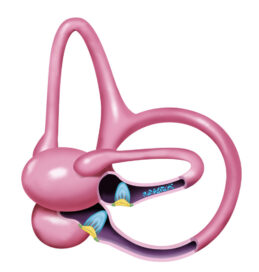
The Li Quick Roll maneuver is a canalith repositioning technique for horizontal canalithiasis benign paroxysmal positional vertigo (BPPV). It uses rapid head and body rotations in the horizontal plane to move free floating otoconia out of the horizontal semicircular canal and back into the utricle. Compared to the traditional barbecue roll maneuver, it is designed as a faster, simplified alternative that relies on fewer positional changes while still using gravity and momentum to achieve debris clearance.
Effectiveness
The maneuver has been shown to be an effective treatment, with outcomes comparable to established techniques. In a randomized controlled trial of 120 patients, success rates with the Li maneuver were 61.7% at 1 day, 80.7% at 3 days, 93.0% at 1 week, and 96.3% at 1 month, with no significant difference compared to the barbecue roll (Li et al., 2018). A larger retrospective study of 254 patients found similar results, with cure rates of 60.5% at day 1, 72.5% at day 3, and 89.2% at day 7 for the Li maneuver, which were statistically no different from the Gufoni maneuver (62.2%, 77.0%, and 90.8% respectively) (Zhao et al., 2021).
History
The treatment was introduced by Junrang Li and colleagues in 2010 as part of a set of “quick repositioning maneuvers” to simplify treatment of BPPV. Building on McClure’s 1985 description of horizontal-canal BPPV and earlier maneuvers like the Barbecue roll and Gufoni, Li designed a faster alternative using fewer positional changes. It was first described in Chinese literature, reported internationally in 2015 as an “easy and effective alternative”, and later validated in a 2018 randomized trials and 2021 comparative study showing outcomes equivalent to established techniques.
Instructions
The purpose of the Li maneuver is to reposition displaced otoconia from the horizontal semicircular canal back into the utricle in cases of horizontal canalithiasis BPPV
Right Ear
- Explain the procedure to the patient and obtain consent.
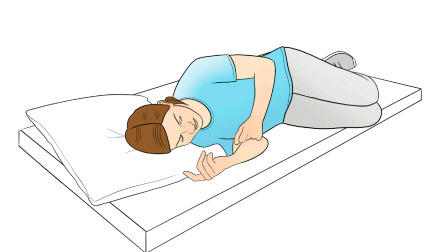
- Start by lying on the right side with the head supported by a pillow, keeping the head in midline and parallel to the floor.
- Quickly have the patient roll onto their back and then directly onto the left side, keeping the head in midline and supported on the pillow throughout the movement. Maintain this left side lying position for 4 minutes.
- Keeping the head in midline, drop the legs off the side of the bed or mat table and slowly sit up. Once returned to sitting, wait here for an additional 60 seconds before standing.
Left Ear
- Explain the procedure to the patient and obtain consent.
- Start by lying on the left side with the head
supported by a pillow, keeping the head in midline and parallel to the floor. - Quickly have the patient roll onto their back and then directly onto the right side, keeping the head in midline and supported on the pillow throughout the movement. Maintain this right side lying position for 4 minutes.
- Keeping the head in midline, drop the legs off the side of the bed or mat table and slowly sit up. Once returned to sitting, wait here for an additional 60 seconds before standing
Patient Focused Handouts (PDFs)

Left ear

Related Pathology
Sources
- Li J, Zou S, Tian S. A prospective randomized controlled study of Li quick repositioning maneuver for geotropic horizontal canal BPPV. Acta Otolaryngol. 2018 Sep;138(9):779-784. doi: 10.1080/00016489.2018.1476778. Epub 2018 Jul 17. PMID: 30015550. https://pubmed.ncbi.nlm.nih.gov/30015550/
- Li J, Li H. New repositioning techniques for benign paroxysmal positional vertigo: the Li repositioning manoeuvres. J Laryngol Otol. 2010 Aug;124(8):905-8. doi: 10.1017/S0022215109992520. Epub 2010 Jan 6. PMID: 20053308. https://pubmed.ncbi.nlm.nih.gov/20053308/
- Zhao P, Li J, Ding Y, Wang Y, Zou S. Li Maneuver for geotropic horizontal canal benign paroxysmal positional vertigo (HC-BPPV) -A better choice. Am J Otolaryngol. 2021 Sep-Oct;42(5):103132. doi: 10.1016/j.amjoto.2021.103132. Epub 2021 Jun 19. PMID: 34216878. https://pubmed.ncbi.nlm.nih.gov/34216878/