
Gufoni Maneuver for Horizontal Canalithiasis
Description
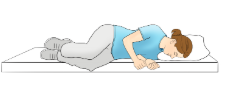
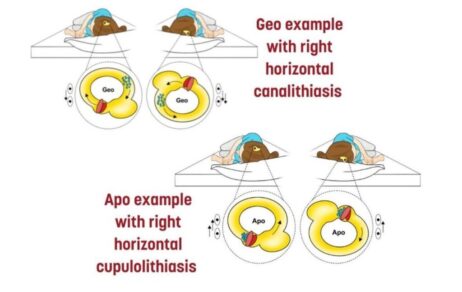
The Gufoni maneuver is a repositioning technique used to treat horizontal canal BPPV (benign paroxysmal positional vertigo) . It involves moving the patient quickly from sitting to a side-lying position, followed by a head turn to help guide displaced otoconia out of the horizontal semicircular canal and back into the utricle. A standard version is used for the geotropic form of horizontal canal BPPV(canalithiasis), while a modified version (sometimes called the Gufoni-Appiani) is used for the apogeotropic form (cupulolithiasis). Compared to the barbecue roll, the maneuver is simpler, faster, and generally less physically demanding for the patient.

Effectiveness
The maneuver is a validated treatment for horizontal canal BPPV, supported by randomized trials and systematic reviews. Early comparative studies found it to be as effective as the barbecue roll, with follow-up success rates often exceeding 80–90% (Kim et al., 2012). A large meta-analysis confirmed that Gufoni is significantly more effective than sham maneuvers and comparable to other repositioning techniques (Fu et al., 2020). In geotropic cases, it may even be superior, with one study by Correia et al. (2021) reporting higher immediate success with Gufoni (68%) compared to barbecue roll (34.8%), but overall resolution of both maneuvers still exceeded 85–90% within one week with repeat attempts. Current guidelines recognize both Gufoni and its modified form (Gufoni-Appiani) as standard treatment options for geotropic and apogeotropic variants (Bhattacharyya et al., 2017).
History
The Gufoni maneuver was first introduced in 1998 by Italian otolaryngologist Mario Gufoni and colleagues as a new treatment option for horizontal canal BPPV, at a time when most repositioning techniques, such as the Epley and Semont, were designed for posterior canal cases. Horizontal canal involvement had only recently been recognized as a distinct variant, and the available treatment (the Lempert “Barbecue” roll, 1994) was effective but more cumbersome, requiring multiple rotations.
The maneuver was initially described in Italian literature in 1998, but it did not reach a broader international audience until 2001, when Ciniglio Appiani and colleagues published the first English-language description. This dissemination established the Gufoni maneuver as an important addition to the clinician’s toolkit.
Instructions
The purpose of the maneuver is to treat horizontal canal BPPV (canalithiasis, geotropic variant) by using rapid side-lying and head-turning movements to shift free-floating otoconia out of the horizontal semicircular canal and back into the utricle, thereby resolving symptoms and nystagmus.
Right Ear
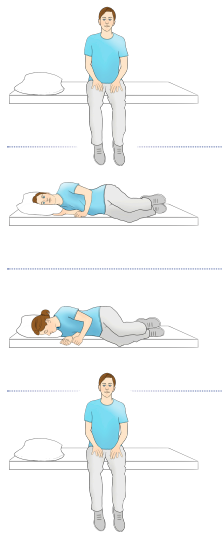
- Explain the procedure to the patient and obtain consent.
- Have the patient sit on the edge of the table or bed, with a pillow placed on the left side.
- Quickly lie the patient down to the left side so that the patient’s head can rest comfortably on the pillow. The head should be parallel to the floor and looking straight ahead. Wait for the dizziness to stop, then wait an additional 60 seconds. If there is no notable dizziness, wait for 60 seconds before moving on to the next position.
- Then have the patient turn their head to the left so that their nose is towards the
floor, and chin tucked towards the shoulder. Wait in this position for 60 seconds. - Keeping the chin tucked, drop the legs off the side of the bed and slowly sit up back to the starting position. Once returned to sitting, wait 60 seconds. Then slowly lift the head so that the patient is looking straight ahead. Wait here for an additional 60 seconds before standing.
Left Ear
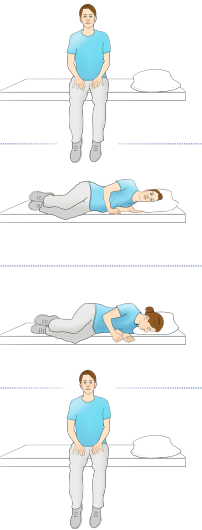
- Explain the procedure to the patient and obtain consent.
- Have the patient sit on the edge of the table or bed, with a pillow placed on the right side.
- Quickly lie the patient down to the right side so that the patient’s head can rest comfortably on the pillow. The head should be parallel to the floor and looking straight ahead. Wait for the dizziness to stop, then wait an additional 60 seconds. If there is no notable dizziness, wait for 60 seconds before moving on to the next position.
- Then have the patient turn their head to the right so that their nose is towards the
floor, and chin tucked towards the shoulder. Wait in this position for 60 seconds. - Keeping the chin tucked, drop the legs off the side of the bed and slowly sit up back to the starting position. Once returned to sitting, wait 60 seconds. Then slowly lift the head so that the patient is looking straight ahead. Wait here for an additional 60 seconds before standing.
Patient Focused Handouts (PDFs)
Left ear
Related Pathology
Sources
- Alashram AR. Gufoni maneuver for treatment of horizontal canal benign paroxysmal positional vertigo: a systematic review of randomized controlled trials. Eur Arch Otorhinolaryngol. 2024 Sep;281(9):4541-4554. doi: 10.1007/s00405-024-08712-y. Epub 2024 May 5. PMID: 38705895. https://pubmed.ncbi.nlm.nih.gov/38705895/
- Bhandari A, Bhandari R, Kingma H, Zuma E Maia F, Strupp M. Three-dimensional simulations of six treatment maneuvers for horizontal canal benign paroxysmal positional vertigo canalithiasis. Eur J Neurol. 2021 Dec;28(12):4178-4183. doi: 10.1111/ene.15044. Epub 2021 Aug 12. PMID: 34339551. https://pubmed.ncbi.nlm.nih.gov/34339551/
- Bhattacharyya N, Gubbels SP, Schwartz SR, Edlow JA, El-Kashlan H, Fife T, Holmberg JM, Mahoney K, Hollingsworth DB, Roberts R, Seidman MD, Steiner RW, Do BT, Voelker CC, Waguespack RW, Corrigan MD. Clinical Practice Guideline: Benign Paroxysmal Positional Vertigo (Update). Otolaryngol Head Neck Surg. 2017 Mar;156(3_suppl):S1-S47. doi: 10.1177/0194599816689667. PMID: 28248609. https://pubmed.ncbi.nlm.nih.gov/28248609/
- Bonni Lynn Kinne, Mikaela Grace Harless, Kyra Ann Lauzon & Jill Renee
Wamhoff (2021): Roll maneuvers versus side-lying maneuvers for geotropic horizontal canal BPPV: a systematic review, Physical Therapy Reviews, DOI: 10.1080/10833196.2021.1978778. https://www.tandfonline.com/doi/full/10.1080/10833196.2021.1978778 - Correia F, Castelhano L, Cavilhas P, Escada P. Lateral semicircular canal-BPPV: Prospective randomized study on the efficacy of four repositioning maneuvers. Acta Otorrinolaringol Esp (Engl Ed). 2021 Jan 22:S0001-6519(20)30198-9. English, Spanish. doi: 10.1016/j.otorri.2020.11.003. Epub ahead of print. PMID: 33494876. https://pubmed.ncbi.nlm.nih.gov/33494876/
- Gufoni M, Mastrosimone L, Di Nasso F. Trattamento con manovra di riposizionamento per la canalolitiasi orizzontale [Repositioning maneuver in benign paroxysmal vertigo of horizontal semicircular canal]. Acta Otorhinolaryngol Ital. 1998 Dec;18(6):363-7. Italian. PMID: 10388148. https://pubmed.ncbi.nlm.nih.gov/10388148/
- Fu W, Han J, Chang N, Wei D, Bai Y, Wang Y, He F, Wang X. Immediate efficacy of Gufoni maneuver for horizontal canal benign paroxysmal positional vertigo (HC-BPPV): a meta-analysis. Auris Nasus Larynx. 2020 Feb;47(1):48-54. doi: 10.1016/j.anl.2019.05.002. Epub 2019 May 28. Erratum in: Auris Nasus Larynx. 2020 Feb;47(1):171-172. doi: 10.1016/j.anl.2019.07.001. PMID: 31151785. https://pubmed.ncbi.nlm.nih.gov/31151785/
- Kim JS, Oh SY, Lee SH, Kang JH, Kim DU, Jeong SH, Choi KD, Moon IS, Kim BK, Kim HJ. Randomized clinical trial for geotropic horizontal canal benign paroxysmal positional vertigo. Neurology. 2012 Aug 14;79(7):700-7. doi: 10.1212/WNL.0b013e3182648b8b. Epub 2012 Aug 1. PMID: 22855868. https://pubmed.ncbi.nlm.nih.gov/22855868/