
Garaycochea Maneuver
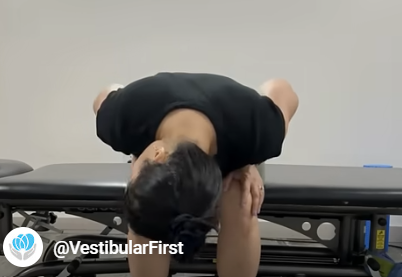
Description
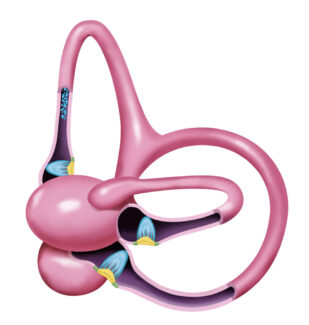
The Garaycochea maneuver, also known as the “novel maneuver” is a forward-bending repositioning technique developed to manage torsional down-beating nystagmus in benign paroxysmal positional vertigo (BPPV), a pattern that can result from either anterior canal BPPV or contralateral apogeotropic (short arm) posterior canal BPPV. By combining trunk flexion, controlled head rotations, and rapid return to sitting, the maneuver directs otoconia from the anterior canal into the utricle—resolving anterior canal BPPV—or, if the pathology lies in the contralateral posterior canal, shifts debris into the ampullary arm, intentionally converting it into a geotropic posterior canalithiasis that can then be treated with a standard Epley maneuver. In this way, the maneuver provides both treatment and a possible means of differential diagnosis between these two uncommon variants.
Effectiveness
In a prospective cohort of 157 BPPV patients, 20 (12.7%) had torsional-vertical down-beating nystagmus, and of the 10 with clear lateralization who underwent the maneuver, all 7 anterior canal cases were resolved and 2 contralateral apogeotropic posterior canal cases were converted into geotropic posterior canal BPPV and successfully treated with an Epley, yielding an overall effectiveness of 100% among treated patients (Garaycochea et al., 2020); in later computer modeling by Cherchi (2025), the maneuver showed ~80% efficacy for anterior canal BPPV and no effect on posterior or horizontal canal variants.
History

Dr. Octavio Garaycochea
The maneuver originated in 2020 within the Department of Otorhinolaryngology at the University of Navarra, where Dr. Octavio Garaycochea and colleagues introduced it as part of a clinical study. It was the first structured attempt to design a single maneuver that addressed both anterior canal and contralateral apogeotropic posterior canal BPPV in one protocol.
Instructions
The purpose of the maneuver is to treat anterior canal BPPV directly and, when present, convert contralateral apogeotropic (short arm) posterior canal BPPV into a geotropic form for treatment with an Epley maneuver.
Right Ear
- Explain the procedure to the patient and obtain consent.
-
Start: Patient seated upright, head flexed ~45° forward. Rotate head toward the left side.
This aligns the right anterior canal (AC) and left posterior canal (PC) with the sagittal plane. -
Forward bend: Quickly flex the trunk ~90° so the head reaches knee level. Hold 1 min.
AC debris moves toward the lowest canal point; APC debris shifts into the non-ampullary arm. -
Head rotation in flexion: Slowly rotate head toward the right side. Hold 1 min.
Encourages debris into the common crus (AC) or lowest point of PC (APC). -
Sit up quickly: With head still toward the right side, bring trunk rapidly upright.
AC debris enters the utricular end via common crus; APC debris shifts into the ampullary arm (conversion to geotropic PC-BPPV). -
Slowly return head to midline, then lift to neutral upright position.
Completes clearance in AC-BPPV, or positions APC-BPPV debris for Epley treatment at follow-up.
Left Ear
- Explain the procedure to the patient and obtain consent.
-
Start: Patient seated upright, head flexed ~45° forward. Rotate head toward the right side.
This aligns the left anterior canal (AC) and right posterior canal (PC) with the sagittal plane. -
Forward bend: Quickly flex the trunk ~90° so the head reaches knee level. Hold 1 min.
AC debris moves toward the lowest canal point; APC debris shifts into the non-ampullary arm. -
Head rotation in flexion: Slowly rotate head toward the left side. Hold 1 min.
Encourages debris into the common crus (AC) or lowest point of PC (APC). -
Sit up quickly: With head still toward the left side, bring trunk rapidly upright.
AC debris enters the utricular end via common crus; APC debris shifts into the ampullary arm (conversion to geotropic PC-BPPV). -
Slowly return head to midline, then lift to neutral upright position.
Completes clearance in AC-BPPV, or positions APC-BPPV debris for Epley treatment at follow-up.

Related Pathology
Sources
- Garaycochea O, Pérez-Fernández N, Manrique-Huarte R. A novel maneuver for diagnosis and treatment of torsional-vertical down beating positioning nystagmus: anterior canal and apogeotropic posterior canal BPPV. Braz J Otorhinolaryngol. 2022 Sep-Oct;88(5):708-716. doi: 10.1016/j.bjorl.2020.09.009. Epub 2020 Oct 28. PMID: 33176986; PMCID: PMC9483926. https://pubmed.ncbi.nlm.nih.gov/33176986/
- Cherchi M. Unilateral Triple Canal Repositioning Maneuver: Principles and Design. Audiol Res. 2025 May 8;15(3):55. doi: 10.3390/audiolres15030055. PMID: 40407669; PMCID: PMC12101378. https://pubmed.ncbi.nlm.nih.gov/40407669/