
The Universal Repositioning Maneuver (URM)
Description
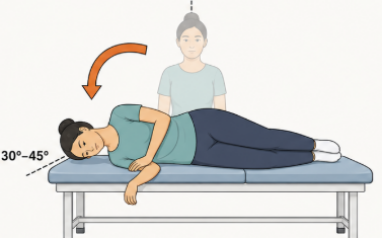
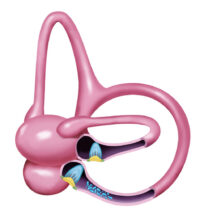
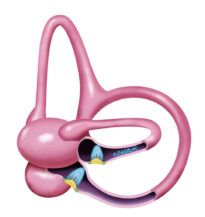
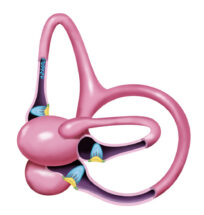
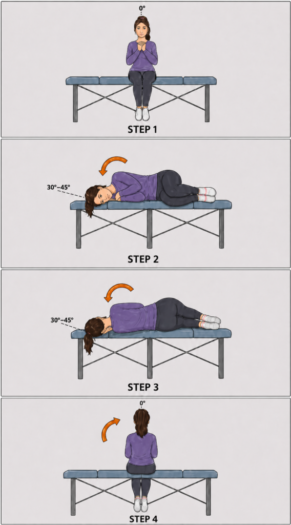
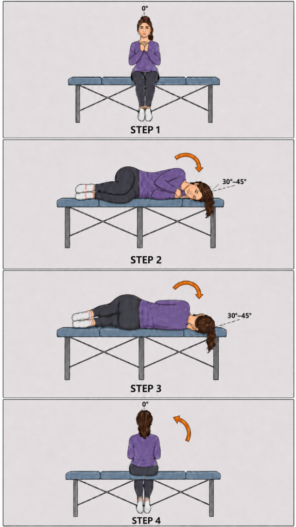
The Universal Repositioning Maneuver is a proposed single treatment sequence for canalithiasis-type BPPV that may help move loose otoconia from any semicircular canal on one side back into the utricle. Unlike traditional BPPV treatment, which usually requires selecting a canal-specific maneuver, this approach is designed to work for posterior, horizontal, anterior, or same-side multi-canal BPPV as long as the affected ear (right or left) is known.
Effectiveness
Clinical evidence for the Universal Repositioning Maneuver remains limited, with one prospective observational study identified for posterior canal BPPV. In that study, 76% of patients treated with the Universal Repositioning Maneuver showed significant post-treatment improvement, compared with 88% treated with Epley; follow-up occurred at 1 week, 1 month, and 3 months, with fewer recurrences reported in the Epley group (Gupta and Lavania, 2025).
History
The Universal Repositioning Maneuver was first described by Barreto et al. in 2023 after testing head-position sequences in the BPPV Viewer 3D labyrinth simulator. Its sequence was adapted from elements of the Li, Gans, Kim, and Zuma maneuvers, then later evaluated clinically by Gupta and Lavania in a 2025 prospective observational comparison with Epley for posterior canal BPPV (Barreto et al., 2023; Gupta and Lavania, 2025).
Instructions
The purpose of the maneuver is to simplify BPPV treatment by using one maneuver for canalithiasis type BPPV affecting any single canal or multiple canals on the same side once the affected ear is identified (Barreto et al., 2023).
Right
- Explain the procedure to the patient and obtain consent.
- Start with the patient sitting upright at the edge of the table or bed, with the head in neutral at 0° and the legs hanging down.
- Help the patient lie onto the right shoulder. Keep the head tilted sideways, or laterally flexed, about 30°–45°. Do not rotate the head horizontally.
- Have the patient roll 180° toward the unaffected side, so they are now lying on the left shoulder. Keep the head laterally flexed about 30°–45°.
- Help the patient sit back up while keeping the head neutral at 0°.
Left
- Explain the procedure to the patient and obtain consent.
- Start with the patient sitting upright at the edge of the table or bed, with the head in neutral at 0° and the legs hanging down.
- Help the patient lie onto the left shoulder. Keep the head tilted sideways, or laterally flexed, about 30°–45°. Do not rotate the head horizontally.
- Have the patient roll 180° toward the unaffected side, so they are now lying on the right shoulder. Keep the head laterally flexed about 30°–45°.
- Help the patient sit back up while keeping the head neutral at 0°.
Right
Left
Related Pathology
Sources
- Barreto RG, Yacovino DA, Cherchi M, Teixeira LJ, Nader SN, Leão GF. Universal Repositioning Maneuver: A New Treatment for Single Canal and Multi-Canal Benign Paroxysmal Positional Vertigo by 3-Dimensional Model Analysis. J Int Adv Otol. 2023 Jun;19(3):242-247. doi: 10.5152/iao.2023.22921. PMID: 37272643; PMCID: PMC10331719. https://pmc.ncbi.nlm.nih.gov/articles/PMC10331719/
- Kumar, Gupta Abhay; Ajay, Lavania1. A Prospective Observational Study on the Efficacy of Epley’s Maneuver versus Universal Repositioning Maneuver in Managing Benign Paroxysmal Positional Vertigo. Indian Journal of Otology 31(4):p 250-254, Oct–Dec 2025. | DOI: 10.4103/indianjotol.indianjotol_54_25 https://journals.lww.com/ijoo/fulltext/2025/10000/a_prospective_observational_study_on_the_efficacy.7.aspx