
Short CRP Maneuver

Description
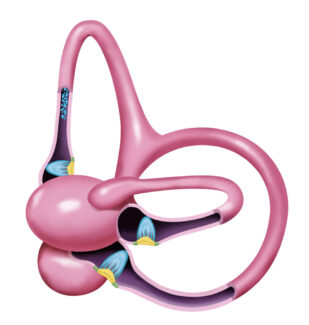
The short CRP (Canalith Repositioning Procedure) is a modification of the classic Epley maneuver designed specifically to treat anterior canalithiasis benign paroxysmal positional vertigo (BPPV). By omitting the side-lying nose-down step (3rd position of the Epley), it minimizes the risk of otoconia returning into the anterior canal and is proposed to improve the likelihood of successful repositioning. This treatment can be useful in patients who can not tolerate the modified Yacovino maneuver.
Effectiveness
Simulation studies by D’Albora et al. (2020) and Bhandari et al. (2021) suggest the short CRP is theoretically effective for anterior canal BPPV by promoting forward otolith progression and avoiding retrograde movement, but its true clinical effectiveness has not yet been confirmed in patient trials.
History

Dr. Ricardo D’Albora Rivas
The treatment originated from a biomechanical analysis by Dr. Ricardo D’Albora Rivas and colleagues in 2020, who studied the Epley maneuver applied to anterior canal BPPV using a 3D labyrinth model. Their simulation showed that two refinements—deeper head-hang (~40°) and omitting the side-lying nose-down step—would better promote otolith progression and reduce retrograde movement, leading them to propose a shortened maneuver (“short CRP”).
In 2021, Bhandari and colleagues tested the maneuver in a fluid dynamic 3D simulator, confirming its theoretical effectiveness but noting it still requires identification of the affected side and that 30° head-hang may be just as effective as 40°. To date, no clinical trials have been published.
Instructions
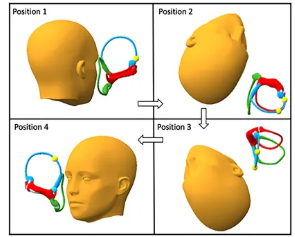
The purpose of the manuever is to treat anterior canal BPPV by using specific head and body movements to guide otoconia out of the anterior canal and back into the utricle, thereby resolving symptoms of vertigo/dizziness and nystagmus.
Right Ear
- Explain the procedure to the patient and obtain consent.
- Start the patient in long sitting, head turned 45° toward the right.
- Move the patient into a deep head-hang (about 40° below horizontal) with the head still turned toward the right side. Hold 30 sec.
- While maintaining the head-hang, rotate the head 90° toward the left. Hold 30 sec.
- Return to sitting upright.
Left Ear
- Explain the procedure to the patient and obtain consent.
- Start the patient in long sitting, head turned 45° toward the left.
- Move the patient into a deep head-hang (about 40° below horizontal) with the head still turned toward the left side. Hold 30 sec.
- While maintaining the head-hang, rotate the head 90° toward the right. Hold 30 sec.
- Return to sitting upright.
Check out our Journal Club on the Short CRP Maneuver
Related Pathology
Sources
- Bhandari A, Bhandari R, Kingma H, Strupp M. Diagnostic and Therapeutic Maneuvers for Anterior Canal BPPV Canalithiasis: Three-Dimensional Simulations. Front Neurol. 2021 Sep 24;12:740599. doi: 10.3389/fneur.2021.740599. PMID: 34630309; PMCID: PMC8497794. https://pubmed.ncbi.nlm.nih.gov/34630309/
- D’Albora Rivas R, Teixido M, Casserly RM, Mónaco MJ. Short CRP for Anterior Canalithiasis: A New Maneuver Based on Simulation With a Biomechanical Model. Front Neurol. 2020 Aug 13;11:857. doi: 10.3389/fneur.2020.00857. PMID: 32903468; PMCID: PMC7438444. https://pubmed.ncbi.nlm.nih.gov/32903468/