
Kim Maneuver for Horizontal Cupulolithiasis
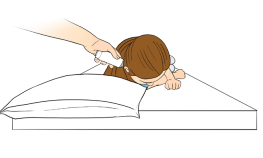
Description
The Kim maneuver, also known as the Cupulolith Repositioning Maneuver (CuRM), is a treatment developed for horizontal cupulolithiasis, the apogeotropic form of horizontal canal BPPV in which otoconia are thought to adhere to either the canal or utricular side of the cupula. Unlike earlier repositioning techniques, the Kim maneuver was designed to be effective regardless of which side the debris is attached to. The maneuver begins with the patient lying supine, followed by a series of five sequential head and body rotations through supine, lateral, and prone positions, each held for several minutes to allow otoconia to move. A key feature is the application of mastoid vibration in certain positions to help detach otoconia from the cupula. By combining positional changes with oscillation, the maneuver aims to guide the otoconia back into the utricle.

Effectiveness
The maneuver has been examined in a limited number of studies for horizontal canal cupulolithiasis. In its original report, 97.4% of 78 patients experienced symptom resolution after an average of 2.1 repetitions, with 61.5% resolving after a single attempt and a 10.8% recurrence rate during follow-up (Kim et al., 2012). A randomized trial later found 36.4% immediate success and 75% final success at follow-up among 28 patients (Lee et al., 2022). A more recent multicenter randomized controlled trial reported a 100% success rate within 4 weeks in patients with apogeotropic horizontal canal BPPV, with outcomes comparable to other approaches such as the Gufoni–Appiani and therapeutic head-shaking (Lee et al., 2023).

History
In 1998, Gufoni introduced a side-lying maneuver that became the first structured approach for treating horizontal canal BPPV, and it was applied to both the geotropic (canalithiasis) and apogeotropic (cupulolithiasis) variants. While this provided a practical starting point, it was not developed exclusively for cupulolithiasis.
Over time, as the distinct pathophysiology of cupula-adhered debris became more accepted, new maneuvers emerged, with Kim and colleagues at Yonsei University in Seoul, South Korea in 2012 described the cupulolith repositioning maneuver (CuRM)—the first to be designed specifically to target horizontal cupulolithiasis by attempting to detach or reposition otoconia from the cupula.
Instructions
The purpose is to treat horizontal cupulolithiasis (apogeotropic) BPPV regardless of whether otoconia are attached to the canal side or utricular side of the cupula.
Right Ear
- Explain the procedure to the patient and obtain consent.
- Start by having the patient lying in supine, with their head in midline.
- Turn the patient completely onto the affected side (right), with their head turned to the right another 45 degrees. The patient should be in right side-lying with their nose pointing toward the floor. Apply vibration over the area around the right mastoid and vibrate for 30 seconds. Have the patient stay in this position for an additional 2 minutes.
- While the patient stays right side-lying, have them turn their head towards the left 45 degrees so that their head is in midline and their nose is parallel to the floor. Have the patient stay in this position for 2 minutes.
- With their head remaining in midline, have the patient roll onto their back so that they are supine, facing the ceiling. Have the patient stay in this position for 2 minutes.
- With their head remaining in midline, roll the patient into left side-lying, with their
nose parallel to the floor. In this position, apply 30 seconds of vibration to the area
around the right mastoid if persistent apogeotropic nystagmus is observed. Have
the patient stay in this position for 2 minutes. - To finish the maneuver, have the patient roll into a prone position with their head at midline, with their nose pointed in the direction of the floor. Have the patient stay in this position for 2 minutes
Left Ear
- Explain the procedure to the patient and obtain consent.
- Start by having the patient lying in supine, with their head in midline.
- Turn the patient completely onto the affected side (left), with their head turned to the left another 45 degrees. The patient should be in left side-lying with their nose pointing toward the floor. Apply vibration over the area around the left mastoid and vibrate for 30 seconds. Have the patient stay in this position for an additional 2 minutes.
- While the patient stays left side-lying, have them turn their head towards the right 45 degrees so that their head is in midline and their nose is parallel to the floor. Have the patient stay in this position for 2 minutes.
- With their head remaining in midline, have the patient roll onto their back so that they are supine, facing the ceiling. Have the patient stay in this position for 2 minutes.
- With their head remaining in midline, roll the patient into right side-lying, with their nose parallel to the floor. In this position, apply 30 seconds of vibration to the area around the left mastoid if persistent apogeotropic nystagmus is observed. Have the patient stay in this position for 2 minutes.
- To finish the maneuver, have the patient roll into a prone position with their head at midline, with their nose pointed in the direction of the floor. Have the patient stay in this position for 2 minutes.
Right ear

Left ear

Related Pathology
Sources
- Kim SH, Jo SW, Chung WK, Byeon HK, Lee WS. A cupulolith repositioning maneuver in the treatment of horizontal canal cupulolithiasis. Auris Nasus Larynx. 2012 Apr;39(2):163-8. doi: 10.1016/j.anl.2011.03.008. Epub 2011 Jun 1. PMID: 21636229. https://pubmed.ncbi.nlm.nih.gov/21636229/
- Lee DH, Park JY, Kim TH, Shin JE, Kim CH. New Therapeutic Maneuver for Horizontal Semicircular Canal Cupulolithiasis: A Prospective Randomized Trial. J Clin Med. 2022 Jul 16;11(14):4136. doi: 10.3390/jcm11144136. PMID: 35887900; PMCID: PMC9324311. https://pubmed.ncbi.nlm.nih.gov/35887900/
- Lee HJ, Jeon EJ, Nam S, Mun SK, Yoo SY, Bu SH, Choi JW, Chung JH, Hong SM, Lee SH, Kim MB, Koo JW, Kim HJ, Seo JH, Ahn SK, Park SN, Kim M, Chung WH. Treatment Efficacy of Various Maneuvers for Lateral Canal Benign Paroxysmal Positional Vertigo With Apogeotropic Nystagmus: A Randomized Controlled Trial. Clin Exp Otorhinolaryngol. 2023 Aug;16(3):251-258. doi: 10.21053/ceo.2023.00619. Epub 2023 Jul 26. PMID: 37499698; PMCID: PMC10471904. https://pubmed.ncbi.nlm.nih.gov/37499698/