
Hot Updates on Concussion
When a concussion happens, our “central computer” for processing sensory input, coordinating eye movements, and so much more can be disrupted.
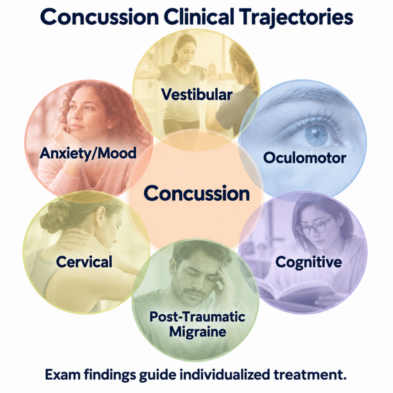
Because everyone’s brain is unique, and the mechanism and force levels during concussion can vary, no two patients with concussion look identical.
A comprehensive post-concussion assessment examines vestibular, oculomotor, cognitive, headache/migraine, anxiety/mood, and cervical elements, as well as sleep, autonomic function, and exercise tolerance (Collins et al., 2014; Patricios et al., 2023). That’s why patients and clinicians can find concussion care so overwhelming at times.
So let’s break concussion care down for everyone. Read on!
1. If you miss this, it’s trouble. Check EVERYONE for BPPV!
Check for BPPV early and then recheck if the patient reports any worsening of balance or dizziness.
- 21-34% of patients with head trauma develop BPPV either acutely or weeks, months, or years after the injury. That’s about 1 in 3 patients post-head injury with BPPV, some of whom will not even report dizziness (Andersson et al., 2022; Smith et al., 2024)
- It can happen in younger people too: 9% of 334 adolescents with acute concussion were found to have BPPV on exam (Covert et al., 2026).
Why treat BPPV in those who don’t feel dizzy?
BPPV can REALLY impact function!
Harrell and Whitney (2025) found that canalith repositioning maneuvers for those with signs of BPPV (yet no dizziness) demonstrated measurable improvements in walking balance.
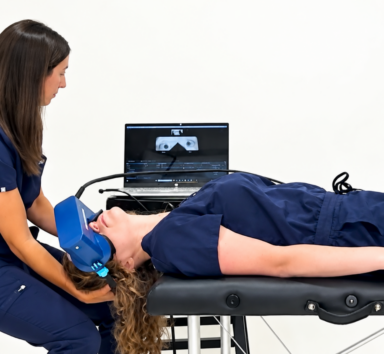
Include positional testing such as the Dix-Hallpike, supine roll test, and straight head hanging test, and lean on classic BPPV nystagmus patterns rather than symptoms.
2. Graded exercise testing is ESSENTIAL.
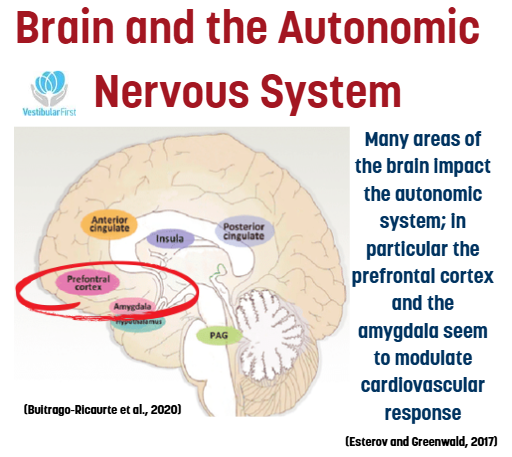
Dizziness post-concussion can in part be caused by exertional or orthostatic intolerance, so use key tools (listed below) to identify patients in need of treatment and possible referral to specialists.
🔥 HOT new printable resource:
Exercise Guideline Concussion Patient Handout
Step 1: Perform 1 of the following Exercise Testing Protocols
- Buffalo Concussion Treadmill Test (BCTT): v1st.co/buffalo
- Pediatric Concussion Treadmill Test: v1st.co/concussionpeds for pediatric patients
OR
- Buffalo Concussion Bike Test (BCBT) – great for those with notable sensitivity to self-motion on a treadmill: v1st.co/buffalobike
If cannot tolerate BCTT/BCBT or no equipment available:
- Buffalo Concussion March Test: v1st.co/buffalomarch
Step 2: Prescribe Submaximal Aerobic Exercise
Recommendations:
- Most patients should start exercising at 80% of the heart rate when symptoms were provoked on the graded exercise test.
- Athletes should exercise at 90% of the heart rate when symptoms were provoked on the exercise test.
- New update: Adults with probable/definite dysautonomia may benefit from the use of mean delta difference (HR δ = 80% age expected max – 80% max HR achieved on BCTT) as a better measure of progress of exercise intolerance treatment (Ziaks et al., 2022).
For a more complicated patient, you may need additional resources:
Orthostatic Intolerance Screening & Treatment Resources
- Orthostatic hypotension: v1st.co/OHtest
- NASA Lean Test: v1st.co/NASAlean
- University of Utah ADaPT Dysautonomia Treatment Protocol: v1st.co/freeADaPT
Specialist Referral Directories
- The Dysautonomia Project: v1st.co/dysproject
- Dysautonomia International: v1st.co/dysint
- The Ehlers Danlos Society Professional Directory: v1st.co/ehlers
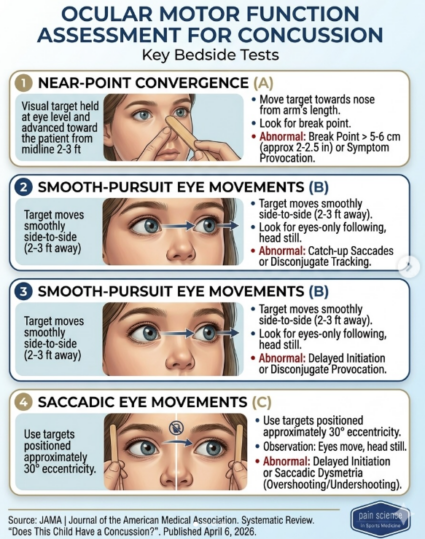
3. Identify Oculomotor Deficits
You may be familiar with the Vestibular/Ocular Motor Screening (VOMS), but have you heard of the Rehabilitation Oculomotor Screening Evaluation (ROSE)?
VOMS primarily measures symptom provocation—headache, dizziness, nausea, and fogginess—during vestibular and eye-movement tasks, along with near-point-of-convergence distance (Mucha et al., 2014).
ROSE adds structured scoring of eye-movement performance, including movement quality, accuracy, and speed, while also recording symptoms. It includes additional checks of eye alignment and gaze fixation, providing more detail about the abnormalities observed during screening (Li et al., 2024).
Clinical takeaway: ROSE may help you document specific findings that warrant further assessment or referral, including when symptom ratings alone do not tell the whole story. Both tools are screens, rather than stand-alone diagnoses.
📄 Access the FREE ROSE instructions and score sheet HERE!
4. Screen the Cervical Spine
See our article on cervicogenic dizziness as featured in our recent prior newsletter.
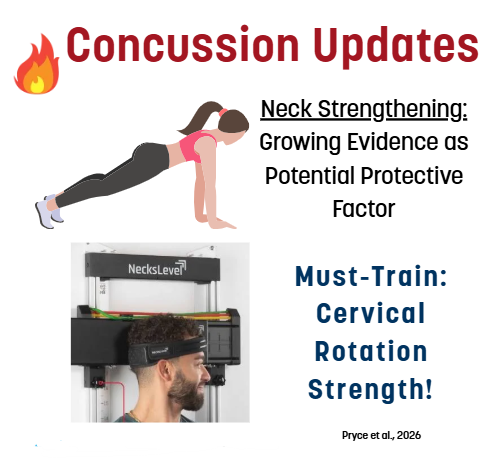
HOT new update: Be sure to strengthen cervical ROTATION muscles to optimize protective factor of neck strength against future concussions (Pryce et al., 2026).
5. Look for Co-Existing Peripheral Vestibular Dysfunction
Don’t miss peripheral vestibular involvement that may impact concussion recovery trajectory!
Peripheral vestibular abnormalities were found in about one-third of people tested with chronic TBI (Taylor et al., 2022).
Why this matters for treatment: Identifying peripheral vestibular hypofunction can guide targeted gaze-stabilization, balance, and gait exercises based on the deficits found (Hall et al., 2022). Persistent dizziness—especially with hearing changes or a history of ear trauma—may also warrant referral for comprehensive vestibular testing (Taylor et al., 2022).

6. Stop the Protocols. Use Individualized, Symptom-Guided Vestibular Rehabilitation.
Vestibular exercises such as VORx1 performed post-concussion at 30% or 70% intensity and at a frequency of once or twice daily had EQUAL improvement on dizziness (Sparto et al., 2026).
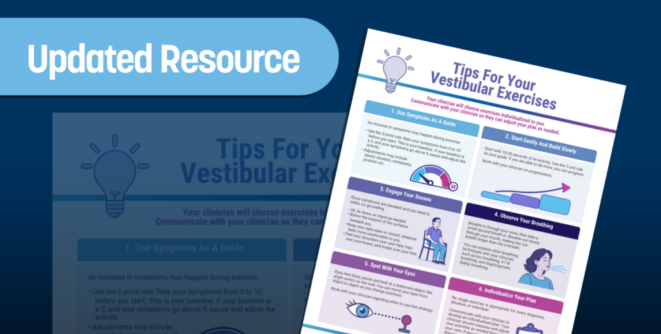
Takeaway: Don’t push so hard on vestibular rehab. Use the 2 unit rule (no more than 2 unit increase from baseline on symptom levels) with any activity, and allow symptoms to return baseline (ideally within 5 minutes) before another stimulating rehab activity.
📥 For the 2 unit rule and other tips during vestibular rehab, download our patient handout!
Learn More With Vestibular First Continuing Education Courses
- Course List
- Foundations of Vestibular Rehabilitation Hybrid Certification Program
- Interested in hosting a course? Find out more and reach out to us HERE!
References
-
Andersson H, Jablonski GE, Nordahl SHG, et al. The risk of benign paroxysmal positional vertigo after head trauma. Laryngoscope. 2022;132(2):443-448. doi:10.1002/lary.29851. Article
-
Collins MW, Kontos AP, Reynolds E, Murawski CD, Fu FH. A comprehensive, targeted approach to the clinical care of athletes following sport-related concussion. Knee Surg Sports Traumatol Arthrosc. 2014;22(2):235-246. doi:10.1007/s00167-013-2791-6. Article
-
Corrado C, Peters AP, Chizuk HM, Leddy JJ, Haider MN. Practical management: guidelines to perform the Pediatric Concussion Treadmill Test. Clin J Sport Med. 2026;36(1):61-65. doi:10.1097/JSM.0000000000001353. Article
-
Covert K, Davis B, Hammonds K, O’Neil M, Mucha A. Risk factors for benign paroxysmal positional vertigo in an acutely concussed adolescent population. J Head Trauma Rehabil. Published online May 8, 2026. doi:10.1097/HTR.0000000000001161. Article
-
Hall CD, Herdman SJ, Whitney SL, et al. Vestibular rehabilitation for peripheral vestibular hypofunction: an updated clinical practice guideline from the Academy of Neurologic Physical Therapy of the American Physical Therapy Association. J Neurol Phys Ther. 2022;46(2):118-177. doi:10.1097/NPT.0000000000000382. Article
-
Harrell RG, Whitney SL. Improvement in functional outcomes in patients with benign paroxysmal positional vertigo. Case Rep Neurol Med. 2025;2025:6611253. doi:10.1155/crnm/6611253. Article
-
Leddy JJ, Haider MN, Ellis M, Willer BS. Exercise is medicine for concussion. Curr Sports Med Rep. 2018;17(8):262-270. doi:10.1249/JSR.0000000000000505. Article
-
Leddy JJ, Haider MN, Ellis MJ, et al. Early subthreshold aerobic exercise for sport-related concussion: a randomized clinical trial. JAMA Pediatr. 2019;173(4):319-325. doi:10.1001/jamapediatrics.2018.4397. Article
-
Li TYZ, Madge K, Richard F, Sarpal P, Dannenbaum E, Fung J. Rehabilitation Oculomotor Screening Evaluation (ROSE)—a proof-of-principle study for acquired brain injuries. J Clin Med. 2024;13(14):4254. doi:10.3390/jcm13144254. Article
-
Mucha A, Collins MW, Elbin RJ, et al. A brief Vestibular/Ocular Motor Screening (VOMS) assessment to evaluate concussions: preliminary findings. Am J Sports Med. 2014;42(10):2479-2486. doi:10.1177/0363546514543775. Article
-
Patricios JS, Schneider KJ, Dvorak J, et al. Consensus statement on concussion in sport: the 6th International Conference on Concussion in Sport–Amsterdam, October 2022. Br J Sports Med. 2023;57(11):695-711. doi:10.1136/bjsports-2023-106898. Article
-
Pryce R, O’Brien R, Dillon J, Fleming N. The effect of a novel 8-week strengthening program on isometric, multidirectional cervical strength in adolescent male rugby players. J Strength Cond Res. Published online October 1, 2026. doi:10.1519/JSC.0000000000005667. Article
-
Smith RM, Burgess C, Beattie J, et al. Treating benign paroxysmal positional vertigo in acute traumatic brain injury: a prospective, randomised clinical trial assessing safety, feasibility, and efficacy. BMJ Neurol Open. 2024;6(1):e000598. doi:10.1136/bmjno-2023-000598. Article
-
Sparto PJ, Kontos AP, Mucha A, et al. Effect of dose of targeted rehabilitation exercises for vestibular (T-REV) impairments following mTBI on dizziness handicap: a randomized clinical trial. J Neurol Phys Ther. 2026;50(3):134-146. doi:10.1097/NPT.0000000000000547. Article
-
Taylor RL, Wise KJ, Taylor D, Chaudhary S, Thorne PR. Patterns of vestibular dysfunction in chronic traumatic brain injury. Front Neurol. 2022;13:942349. doi:10.3389/fneur.2022.942349. Article
-
UBMD Orthopaedics & Sports Medicine. Exertion test resources. Accessed October 21, 2026. Test manuals and resources
-
Ziaks L, Tucker J, Koc T, Hanson K, Puxted F. Measurement of improvement on repeat exercise intolerance testing for suspected dysautonomia in protracted concussion recovery: a retrospective cohort study. Physiother Theory Pract. 2024;40(3):468-476. doi:10.1080/09593985.2022.2121949. Article