
General Principles of Vestibular Rehabilitation
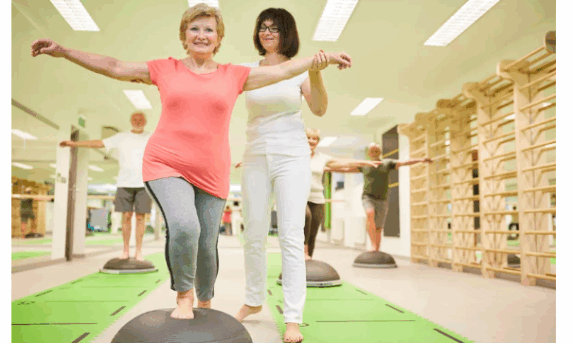
Vestibular rehabilitation (VR, or vestibular rehabilitation therapy – VRT) is a specialized form of exercise and education used to treat vestibular disorders and their symptoms, which may include dizziness, vertigo, imbalance, postural issues, and/or unexplained falls.
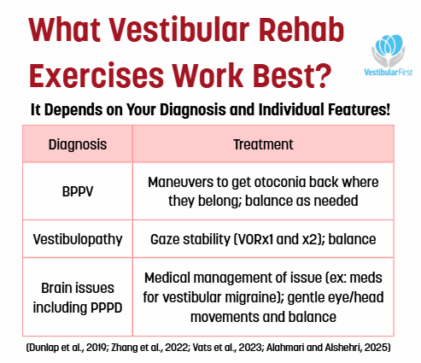
Vestibular symptoms often result due to sensory mismatches between vision, the vestibular system (inner ear balance system), and joint proprioception (sense of joint position in space). Sometimes, vestibular symptoms are due to a mechanical issue in the inner ear (Benign Paroxysmal Positional Vertigo or BPPV), where tiny crystals that help sense gravity in the inner ear go in the wrong part of the inner ear. The treatment for BPPV should involve putting the crystals back where they belong with head and body movements (maneuvers) such as the Epley, followed sometimes by other vestibular rehabilitation strategies (see below) as needed.
🧠 Promoting central compensation – Central compensation occurs when the brain makes changes (neuroplasticity) to compensate for impaired vestibular input and/or to improve the ability to use non-damaged sensory inputs such as proprioception to orient oneself. This reweighting of sensory information can reduce dizziness and improve balance.
👁️ Improving gaze stability – The ability to keep one’s eyes fixed on an object, without that object getting blurry or double, while the head is moving is known as gaze stability. Certain types of vestibular rehabilitation exercises can promote gaze stability for some patients, depending on the root cause of the symptoms (pathology).
🌊 Reducing sensitivity to self and/or visual motion – Certain stimuli such as self-motion (e.g. bending down/coming up) or visual motion (such as watching a train speed past) can cause dizziness in some people. This is usually due to an issue known as visual vertigo or visual dependence. Sensitivity to self or visual motion may be reduced with gentle, repeated exposure to the challenging stimuli, in conjunction with certain cues such as increasing attention to proprioceptive input. Broadly, this is a form of central compensation.
⚖️ Enhancing effective balance strategies – Balance means the ability to maintain one’s body position safely, whether sitting, standing, walking, turning, or changing position. Balance training can involve many elements, depending on the individual’s exact cause of vestibular symptoms, their cognitive status, and their prior level of physical ability before the vestibular condition occurred. Options for training can include sensory reweighting (as described in the central compensation section above), strengthening key muscles such as at the core and hips, and recovery strategies such as stepping catch oneself after tripping.
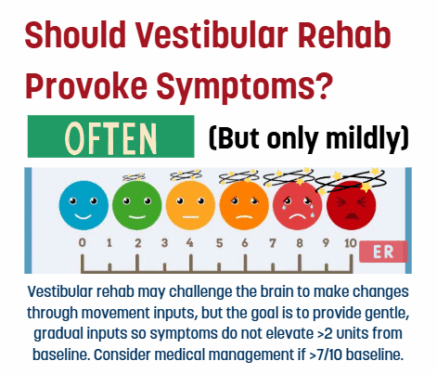
Each patient’s program should be tailored to their symptoms, goals, and tolerance. Clinical practice guidelines recommend monitoring symptom provocation and avoiding excessive or prolonged exacerbation, as progressing exercises too quickly can interfere with compensation (Hall et al., 2022). Progression typically occurs when symptoms during or after exercises remain manageable and short-lived.
In addition to guideline-supported principles, clinical teaching and expert practice often use simple 0–10 symptom rating scales to track tolerance and guide progression. While this approach is common, specific numeric thresholds (e.g., limiting increases to ≤2 points) are not defined in published research or guidelines and instead reflect practical teaching strategies that should be applied with clinical judgment.

Common Elements of a Vestibular Rehabilitation Program
GAZE STABILIZATION
Gaze stability is the ability to keep a target clear while the head is moving. This relies heavily on the vestibulo-ocular reflex (VOR), an automatic reflex that moves the eyes equal and opposite to head movement so the image stays steady on the retina (Han 2011). When the VOR is reduced or mismatched, patients may report blurred or “bouncing” vision with head movement (oscillopsia), dizziness, or unsteadiness.
Gaze stabilization exercises are designed to improve this by using brief, controlled retinal slip (a small “error signal”) to help recalibrate the VOR over time (Han 2011; Hall et al. 2022). They are strongly supported for unilateral and bilateral peripheral vestibular hypofunction (Hall et al. 2022) and may also be included within broader rehab programs for people with motion/visual provocation and some post-stroke presentations, depending on the individual and goals (Chang & Schubert 2021; Zhang 2022; Meng et al. 2023; Nairn et al. 2025).
💡Clinical Importance
To get the intended training effect, the head must move fast enough to challenge the system while the patient maintains accurate fixation on the target (Han 2011; Hall et al. 2022). Using near targets (including convergence-based variations) can increase demand and may be a helpful progression option in unilateral hypofunction (Chang & Schubert 2021). With consistent practice, patients can improve dynamic visual acuity and show carryover to functional mobility (balance and gait-related measures) in peripheral hypofunction (Clendaniel 2010; Hall et al. 2022).
👁️Types of Exercises
-
VOR x1: head rotation with fixation on a stationary target (Han 2011; Hall et al. 2022).
-
VOR x2: head and target move in opposite directions (Han 2011).
-
Near-target or convergence-enhanced VOR tasks (Chang & Schubert 2021).
-
Walking with x1 to integrate gaze stabilization into gait (Han 2011; Hall et al. 2022).
-
VOR x1 in visually complex environments as a progression (Han 2011).
Example of a VOR progression:
Example of gaze stabilization with obstacle negotiation:
GAZE SUBSTITUTION
Gaze substitution exercises are commonly performed when vestibulo-ocular reflex (VOR) recovery is limited. Sometimes the VOR cannot generate enough eye movement to keep vision clear during head motion. In these cases, patients rely more on compensatory strategies—such as predictive (“pre-programmed”) catch-up saccades, smooth pursuit/visual tracking, and increased use of visual and cervical somatosensory cues—to help keep their eyes on target during movement (Han 2011; BSA 2019).
This approach is most relevant in bilateral vestibulopathy (regardless of cause, including ototoxic injury and other severe bilateral losses), long-standing or poorly compensated peripheral vestibular hypofunction, and selected central vestibular disorders where restoring normal VOR gain is less likely and functional compensation becomes the priority (Han 2011; BSA 2019; Zhang 2022).
💡Clinical Importance
When the VOR does not fully stabilize vision, patients often develop compensatory saccades to re-fixate on the target (Anson et al. 2016). Substitution training aims to make these strategies more consistent and efficient, so patients can keep vision clearer during daily tasks that involve quick gaze shifts, busy visual environments, or unexpected head movement (BSA 2019; Zhang 2022).
🎯Types of Exercises
-
Predictive saccadic gaze shifts between fixed targets (Han 2011).
-
Remembered-target gaze shifts based on internally stored visual information (Han 2011).
-
Smooth-pursuit tasks with small head movements used as compensatory, not restorative, strategies (Hall et al. 2022).
An example of a gaze substitution progression:
Example of an imaginary target progression:
SENSORY RE-WEIGHTING
Sensory reweighting means the brain is learning how to prioritize different balance inputs: vision (what you see), the vestibular system (inner ear motion sensing), and somatosensation/proprioception (feedback from joints, muscles, and the feet on the ground). When one input is less reliable, or when the brain relies too heavily on a single input, symptoms can increase. Sensory reweighting exercises aim to improve this balance by practicing movement and posture under different sensory conditions (Han 2011; BSA 2019).
This often includes habituation tasks, which are graded exposure exercises. Habituation is not “pushing through.” It is repeated, controlled practice of a symptom-triggering movement or environment (at a tolerable dose) so the nervous system becomes less sensitive over time (Han 2011). Sensory-integration training builds on this by changing the task conditions—such as practicing on different surfaces, with reduced visual input, or with added head motion—so the patient learns to stay stable even when one sensory system is less helpful (BSA 2019; Appiah-Kubi et al. 2019; Appiah-Kubi et al. 2022).
💡Clinical Importance
Many patients notice worse symptoms when sensory demands shift—such as with bending, turning, walking in dim lighting, or being in visually busy spaces (stores, crowds, scrolling patterns). In these settings, patients may show visual dependence (over-reliance on vision for balance) or visual motion sensitivity (symptoms triggered by moving visual scenes). A common strategy is graded exposure to these triggers while coaching grounding cues (feet pressure, posture, breathing, controlled head/eye movement) so symptoms become more manageable and recover more quickly (Han 2011).
In PPPD, symptoms are often aggravated by upright posture, motion, and complex visual environments, so structured exposure to those environments is often paired with pacing and confidence-building to reduce avoidance and improve tolerance (Alahmari & Alshehri 2025; Madrigal 2024). Combining vestibular challenge with coordinated weight shifting and postural control tasks can further train how the CNS blends sensory inputs—especially in patients with chronic vestibular symptoms, visual-motion sensitivity, PPPD, or post-stroke sensory-integration deficits (Appiah-Kubi et al. 2019; Appiah-Kubi et al. 2022; Zhang 2022; Madrigal 2024).
🌀Types of Exercises
-
Repeated exposure to provocative movements such as bending, turning, or position changes (Han 2011).
-
Optokinetic or visual-motion exposure (e.g., moving patterns, visually busy environments) (Han 2011; BSA 2019).
-
Balance tasks with altered sensory conditions such as foam, reduced vision, or variable support surfaces (Han 2011; Appiah-Kubi et al. 2019).
-
Combined vestibular stimulation and weight-shifting activities to improve multisensory integration (Appiah-Kubi et al. 2022).
An example of a habituation progression to movement:
An example of a habituation progression to visual motion for returning to driving:
STATIC AND DYNAMIC BALANCE
Balance training helps patients control their center of mass (their body’s “weight center”) over their base of support (feet, assistive device, or seat) during real-life tasks like standing, walking, turning, and changing direction. It also targets two key balance systems:
-
Anticipatory balance: the “pre-planned” adjustments your body makes before you move (for example, shifting weight before stepping).
-
Reactive balance: the “righting” responses that happen after an unexpected challenge (for example, a slip, trip, or being bumped).
Training often uses variable surfaces and movement demands (e.g., firm vs. compliant surfaces, narrow stance, head turns, turning, obstacle negotiation) to build steadier postural control under different conditions (Han 2011; Hall et al. 2022).
💡Clinical Importance
The 2022 Clinical Practice Guideline (CPG) describes balance and gait training as a core part of vestibular rehabilitation, alongside gaze-stability and habituation work, because improving postural stability and safe mobility is a primary goal of care (Hall et al. 2022). In stroke populations, systematic reviews and meta-analyses report that vestibular rehabilitation programs can improve balance and may improve gait-related outcomes, although results vary across protocols and outcome measures (Meng et al. 2023; Nairn et al. 2025). These changes support balance training as a key component for fall-risk reduction and functional mobility.
🚶Types of Exercises
-
Static stance progressions such as Romberg, tandem, and single-leg stance (Han 2011; Hall et al. 2022).
-
Dynamic balance tasks including weight shifting, reaching, and multidirectional stepping (Han 2011).
-
Reactive balance challenges using manual perturbations or unstable surfaces (Han 2011; Hall et al. 2022).
-
Multisensory balance tasks with altered vision or diverse support surfaces (Han 2011).
-
Gait training with head movement or directional changes to challenge stability in motion (Meng et al. 2023; Nairn et al. 2025).
Example of single leg dynamic balance challenges:
Example of a dynamic gait exercise:
FUNCTIONAL AND TASK-SPECIFIC TRAINING
Functional training incorporates gaze, balance, and sensory strategies into everyday movements—walking, turning, navigating obstacles, and performing work or recreational tasks (BSA 2019; Hall et al. 2022).
💡Clinical Importance
Functional disability in vestibular disorders often persists because symptoms worsen during multitasking, complex environments, rapid transitions, and real-world interactions—not during isolated clinic exercises. Systematic reviews in stroke (Meng et al. 2023; Nairn et al. 2025) show that task-specific gait and dual-task training improve community mobility, obstacle negotiation, and turning stability. In PPPD, graded functional exposure decreases avoidance behaviors and increases participation in daily activities (Alahmari & Alshehri 2025; Madrigal et al. 2024). This intervention targets real-world performance and participation, rather than addressing impairments alone.
↔️Types of Exercises
-
Walking with head turns or visual-scanning tasks to integrate gaze, posture, and mobility (Hall et al. 2022).
-
Dual-task walking with cognitive load or upper-extremity tasks (Nairn et al. 2025).
-
Obstacle negotiation or uneven-surface walking to challenge adaptability and turning stability (Meng et al. 2023).
-
ADL-specific mobility such as sit-to-stand, bed mobility, stair negotiation, or tight-space turning (BSA 2019).
-
Work- or sport-specific movement sequences that reflect patient-identified functional goals (BSA 2019).
Example of functional task training preparing a patient to be able to walk their dog:
Example of functional task training preparing a patient to be able to carry laundry:
EXERCISE DOSAGE, INTENSITY AND PROGRESSION
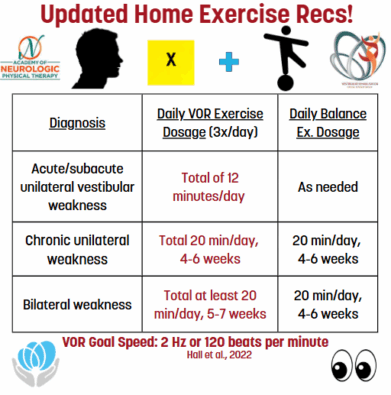
Exercise dosage refers to how often, how long, and how intensely vestibular exercises are performed. The updated Clinical Practice Guideline (CPG) gives the strongest dosing recommendations for peripheral vestibulopathy (Hall et al. 2022). Research also reinforces the need for consistent, progressively challenging practice.
💡Clinical Importance
The 2022 CPG identifies under-dosing—too little practice or insufficient challenge—as a major cause of poor outcomes in those with peripheral vestibulopathy (Hall et al. 2022). Even short, once-daily VOR sessions can improve VOR gain when progressed appropriately (Rinaudo et al. 2021).
Dosing must be individualized. Patients with PPPD or anxiety often need slower progression because symptoms are influenced by emotional and visual-motion sensitivity (Alahmari & Alshehri 2025; Madrigal et al. 2024). Adherence improves when dosing expectations are clear and tailored (Im et al. 2025; Kalderon et al. 2024).
In stroke and other central conditions, consistent vestibular-informed training improves balance and gait, though optimal dosing parameters remain under studied (Meng et al. 2023; Nairn et al. 2025).
📈Progression Principles Supported by Evidence
-
Change one variable at a time (surface, speed, head movement, cognitive load) (Hall et al. 2022).
-
Progress when symptoms are brief and recover quickly, not when they are prolonged (Dunlap et al. 2019).
-
Use incremental increases in intensity—faster head speeds, smaller targets—to drive adaptation (Rinaudo et al. 2021).
-
Consider psychological factors—PPPD symptoms intensify with anxiety and avoidance (Alahmari & Alshehri 2025; Madrigal et al. 2024).
-
Support adherence through clear instructions and structured home programs (Im et al. 2025; Kalderon et al. 2024).

PATIENT EDUCATION AND SELF-MANAGEMENT STRATEGIES
Education helps patients understand why exercises work, what symptoms to expect, how to pace activity, and how to stay safe during rehabilitation. Self-management includes following a structured home program and gradually re-entering visually or motion-demanding environments. These strategies support recovery in peripheral vestibular disorders, chronic dizziness, and central conditions (BSA 2019; Han 2011; Hall et al. 2022).
💡Clinical Importance
Patients improve more consistently when expectations and home-practice instructions are clear. Education that explains normal symptom responses, pacing, and safety reduces fear and avoidance and increases adherence (BSA 2019; Han 2011; Hall et al. 2022). Clear self-management plans also support long-term progress in chronic or fluctuating vestibular conditions.
🧑🏫Core Elements
-
Explain key mechanisms.
-
Normalize brief, expected symptom increases during exercises.
-
Provide a structured home plan with clear frequency and duration.
-
Teach graded re-exposure to visually or motion-busy environments.
-
Reinforce long-term maintenance strategies, especially when symptoms are fluctuating or chronic.
Learn more about vestibular therapy and specific interventions:
- NEW Vestibular First online and in-person CEU courses, including bundles to SAVE!
- Foundations of Vestibular Rehabilitation
- General
- Beginner course provider examples
- Intermediate course provider examples
- Advanced course provider examples
- Follow on Instagram
References
- Alahmari KA, Alshehri S. Evaluating the efficacy of vestibular rehabilitation therapy on quality of life in persistent postural-perceptual dizziness: the role of anxiety and depression in treatment outcomes. Front Neurol. 2025 Feb 4;16:1524324. doi: 10.3389/fneur.2025.1524324. PMID: 39968458; PMCID: PMC11834867. https://pubmed.ncbi.nlm.nih.gov/39968458/
- Anson ER, Bigelow RT, Carey JP, Xue QL, Studenski S, Schubert MC, Agrawal Y. VOR gain is related to compensatory saccades in healthy older adults. Front Aging Neurosci. 2016;8:150. doi:10.3389/fnagi.2016.00150 https://pubmed.ncbi.nlm.nih.gov/27445793/
- Appiah-Kubi KO, Wright WG. Vestibular training promotes adaptation of multisensory integration in postural control. Gait Posture. 2019 Sep;73:215-220. doi: 10.1016/j.gaitpost.2019.07.197. Epub 2019 Jul 16. PMID: 31376748. https://pubmed.ncbi.nlm.nih.gov/31376748/
- Appiah-Kubi KO, Laing E, Imtiaz MH. A Study Protocol to Evaluate the Effects of Vestibular Training on the Postural Control of Healthy Adults Using Virtual Reality. Applied Sciences. 2022; 12(23):11937. https://doi.org/10.3390/app122311937
- Bhattacharyya N, Gubbels SP, Schwartz SR, Edlow JA, El-Kashlan H, Fife T, Holmberg JM, Mahoney K, Hollingsworth DB, Roberts R, Seidman MD, Steiner RW, Do BT, Voelker CC, Waguespack RW, Corrigan MD. Clinical Practice Guideline: Benign Paroxysmal Positional Vertigo (Update). Otolaryngol Head Neck Surg. 2017 Mar;156(3_suppl):S1-S47. doi: 10.1177/0194599816689667. PMID: 28248609. https://pubmed.ncbi.nlm.nih.gov/28248609/
- British Society of Audiology. Practice Guidance: Vestibular Rehabilitation. British Society of Audiology; 2019. https://www.thebsa.org.uk/wp-content/uploads/2019/10/Vestibular-Rehabilitation.pdf
- Chang TP, Schubert MC. Convergence vestibulo-ocular reflex in unilateral vestibular hypofunction: behavioral evidence in support of a novel gaze stability exercise. J Neurol Phys Ther. 2021;45(1):3-11. doi:10.1097/NPT.0000000000000335 https://pubmed.ncbi.nlm.nih.gov/33065632/
- Clendaniel RA. The effects of habituation and gaze stability exercises in the treatment of unilateral vestibular hypofunction: preliminary results. J Neurol Phys Ther. 2010;34(2):111-116. doi:10.1097/NPT.0b013e3181deca01 https://pubmed.ncbi.nlm.nih.gov/20588098/
- Dunlap PM, Holmberg JM, Whitney SL. Vestibular rehabilitation: advances in peripheral and central vestibular disorders. Curr Opin Neurol. 2019 Feb;32(1):137-144. doi: 10.1097/WCO.0000000000000632. PMID: 30461465. https://pubmed.ncbi.nlm.nih.gov/30461465/
- Ferri N, Morone G, Piermaria J, Manzari L, Turolla A, De Tanti A, Ciancarelli I, Pillastrini P, Tramontano M. Knowledge, Barriers, and Future Directions of Vestibular Rehabilitation Practice in Neurorehabilitation: An Italian Survey. Healthcare (Basel). 2024 Dec 25;13(1):22. doi: 10.3390/healthcare13010022. PMID: 39791629; PMCID: PMC11719692. https://pubmed.ncbi.nlm.nih.gov/39791629/
- Hall CD, Herdman SJ, Whitney SL, et al. Vestibular rehabilitation for peripheral vestibular hypofunction: an updated clinical practice guideline from the Academy of Neurologic Physical Therapy of the American Physical Therapy Association. J Neurol Phys Ther. 2022;46(2):118-177. doi:10.1097/NPT.0000000000000382 https://pubmed.ncbi.nlm.nih.gov/34864777/
- Han BI, Song HS, Kim JS. Vestibular rehabilitation therapy: review of indications, mechanisms, and key exercises. J Clin Neurol. 2011 Dec;7(4):184-96. doi: 10.3988/jcn.2011.7.4.184. Epub 2011 Dec 29. PMID: 22259614; PMCID: PMC3259492. https://pubmed.ncbi.nlm.nih.gov/22259614/
- Im YH, Lee HJ, Jeon EJ. Adherence to customized vestibular rehabilitation therapy: influencing factors and clinical implications in vestibulopathy. Front Neurol. 2025 Feb 5;16:1538989. doi: 10.3389/fneur.2025.1538989. PMID: 40040913; PMCID: PMC11878102. https://pmc.ncbi.nlm.nih.gov/articles/PMC11878102/
- Kalderon L, Kaplan A, Wolfovitz A, Levy-Tzedek S, Gimmon Y. Barriers and Facilitators of Vestibular Rehabilitation: Patients and Physiotherapists’ Perspectives. J Neurol Phys Ther. 2024 Jul 1;48(3):140-150. doi: 10.1097/NPT.0000000000000470. Epub 2024 Mar 1. PMID: 38426842; PMCID: PMC11208053. https://pubmed.ncbi.nlm.nih.gov/38426842/
- Lacour M, Helmchen C, Vidal PP. Vestibular compensation: the neuro-otologist’s best friend. J Neurol. 2016;263(suppl 1):S54-S64. doi:10.1007/s00415-015-7903-4 https://pubmed.ncbi.nlm.nih.gov/27083885/
- Madrigal J, Herrón-Arango AF, Bedoya MJ, Cordero Chen J, Castillo-Bustamante M. Persistent Challenges: A Comprehensive Review of Persistent Postural-Perceptual Dizziness, Controversies, and Clinical Complexities. Cureus. 2024 May 23;16(5):e60911. doi: 10.7759/cureus.60911. PMID: 38910644; PMCID: PMC11193666. https://pubmed.ncbi.nlm.nih.gov/38910644/
- Meng L, Liang Q, Yuan J, Li S, Ge Y, Yang J, Tsang RCC, Wei Q. Vestibular rehabilitation therapy on balance and gait in patients after stroke: a systematic review and meta-analysis. BMC Med. 2023 Aug 25;21(1):322. doi: 10.1186/s12916-023-03029-9. PMID: 37626339; PMCID: PMC10464347. https://pubmed.ncbi.nlm.nih.gov/37626339/
- Nairn B, Koohi N, Kaski D, Bamiou DE, Pavlou M. Impact of Vestibular Rehabilitation and Dual-Task Training on Balance and Gait in Survivors of Stroke: A Systematic Review and Meta-Analysis. J Am Heart Assoc. 2025 Jun 3;14(11):e040663. doi: 10.1161/JAHA.124.040663. Epub 2025 May 23. PMID: 40407062; PMCID: PMC12229107.https://pmc.ncbi.nlm.nih.gov/articles/PMC12229107/
- Rinaudo CN, Schubert MC, Cremer PD, Figtree WVC, Todd CJ, Migliaccio AA. Once-daily incremental vestibular-ocular reflex adaptation training in patients with chronic peripheral vestibular hypofunction: a 1-week randomized controlled study. J Neurol Phys Ther. 2021;45(2):87-100. doi:10.1097/NPT.0000000000000348 https://pubmed.ncbi.nlm.nih.gov/33675600/
- Sulway S, Whitney SL. Advances in vestibular rehabilitation. Adv Otorhinolaryngol. 2019;82:164-169. doi:10.1159/000490285 https://pubmed.ncbi.nlm.nih.gov/30947180/
- Tramontano M, Haijoub S, Lacour M, Manzari L. Updated views on vestibular physical therapy for patients with vestibular disorders. Healthcare (Basel). 2025;13(5):492. doi:10.3390/healthcare13050492 https://pubmed.ncbi.nlm.nih.gov/40077054/
- Tsukamoto HF, Costa Vde S, Silva RA Junior, Pelosi GG, Marchiori LL, Vaz CR, Fernandes KB. Effectiveness of a Vestibular Rehabilitation Protocol to Improve the Health-Related Quality of Life and Postural Balance in Patients with Vertigo. Int Arch Otorhinolaryngol. 2015 Jul;19(3):238-47. doi: 10.1055/s-0035-1547523. Epub 2015 May 6. PMID: 26157499; PMCID: PMC4490916. https://pubmed.ncbi.nlm.nih.gov/26157499/
- Vats AK, Kothari S, Biswas A. Vestibular Rehabilitation of the Persons affected by Benign Paroxysmal Positional Vertigo (BPPV) by Physical Therapy and Repositioning Maneuvers. Ann Indian Acad Neurol. 2023 Jan;26(Suppl 1):S1-S9. doi: 10.4103/aian.aian_1105_21. Epub 2022 May 3. PMID: 37092021; PMCID: PMC10114537. https://pubmed.ncbi.nlm.nih.gov/37092021/
- Zhang S, Liu D, Tian E, Wang J, Guo Z, Kong W. Central vestibular dysfunction: don’t forget vestibular rehabilitation. Expert Rev Neurother. 2022 Aug;22(8):669-680. doi: 10.1080/14737175.2022.2106129. Epub 2022 Aug 3. PMID: 35912850. https://pubmed.ncbi.nlm.nih.gov/35912850/