
Dias Maneuver
Description
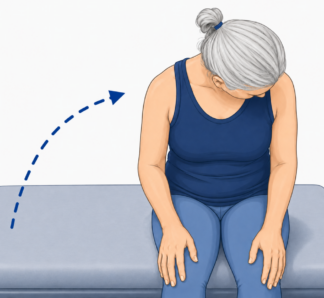
The Dias repositioning maneuver, described as a supine-to-seated approach, is a newer treatment option for posterior canalithiasis BPPV. Because it does not require side-lying or rolling across the treatment table, it may be useful for patients who have difficulty with larger body-position changes, including some older adults, people with higher body weight, and those with orthopedic, postsurgical, or mobility restrictions.
Effectiveness
In one study, the Dias maneuver resolved positional vertigo and nystagmus in 85% of patients after one maneuver and 94% after one or two maneuvers performed the same day. Because there was no comparison group, these results suggest the maneuver may be effective, but they do not prove it is better than established options such as the Epley or Semont maneuvers (Rocha & Lefèvre, 2023).
History
The Dias Repositioning Maneuver was published by Rocha and Lefèvre in 2023 as a newer posterior canal BPPV treatment option. Although the article names the technique the “Dias Repositioning Maneuver,” it does not explain the origin of the name “Dias” (Rocha & Lefèvre, 2023).
Instructions
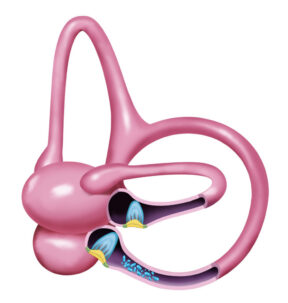
The purpose is to move displaced otoconia from the posterior semicircular canal back toward the utricle.
Right
- Begin with the patient sitting upright on the treatment table.
- Place a cushion at the level of the patient’s chest.
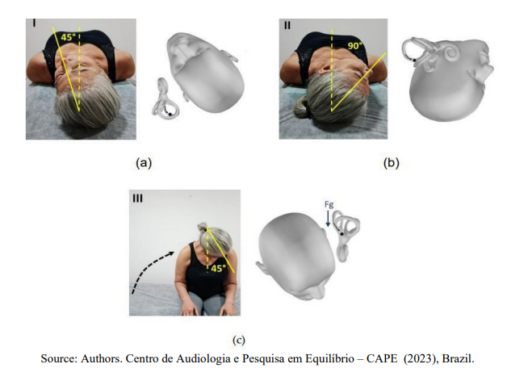
- Have the patient lie back into a supine position with the head extended about 20° and rotated 45° to the right.
- Hold this position for 1 minute after the nystagmus stops.
- Rotate the patient’s head 135° toward the left. The head should end approximately 90° to the left of neutral.
- Hold this position for 2 minutes.
- Have the patient sit up with the legs off the table, keeping the head tilted down and rotated 45° to the right.
- Hold this final position for 2 minutes.
Left
- Begin with the patient sitting upright on the treatment table.
- Place a cushion at the level of the patient’s chest.
- Have the patient lie back into a supine position with the head extended about 20° and rotated 45° to the left.
- Hold this position for 1 minute after the nystagmus stops.
- Rotate the patient’s head 135° toward the right. The head should end approximately 90° to the right of neutral.
- Hold this position for 2 minutes.
- Have the patient sit up with the legs off the table, keeping the head tilted down and rotated 45° to the left.
- Hold this final position for 2 minutes.
Image shown is an example of the treatment sequence for left-sided posterior canalithiasis BPPV.
Related Pathology
Sources
Rocha GD, Lefèvre AP. Proposal of an otolith repositioning maneuver for posterior canal benign paroxysmal positional vertigo: a supine-seated approach. Research, Society and Development. 2023;12(4):e21212441173. doi:10.33448/rsd-v12i4.41173