
Can Medication Fix Dizziness?

📊 Approximately 60% of patients diagnosed with vestibular disorders in the Emergency Department (ED) are prescribed meclizine (Newman-Toker et al., 2009).
⚖️ Some medications have benefits and risks – do they outweigh each other? Let’s explore Meclizine as an example:
🧠 How it works: Meclizine is both an antihistamine and anticholinergic medication.
- Antihistamine – acts to reduce dizziness by inhibiting signals from the vestibular nuclei, therefore decreasing sensitivity of the vestibular apparatus temporarily;
- Anticholinergic – acts to reduce nausea by decreasing activity in the vestibular nuclei and nausea areas (e.g. medulla) in the central nervous system (brain).
✅ Benefits:
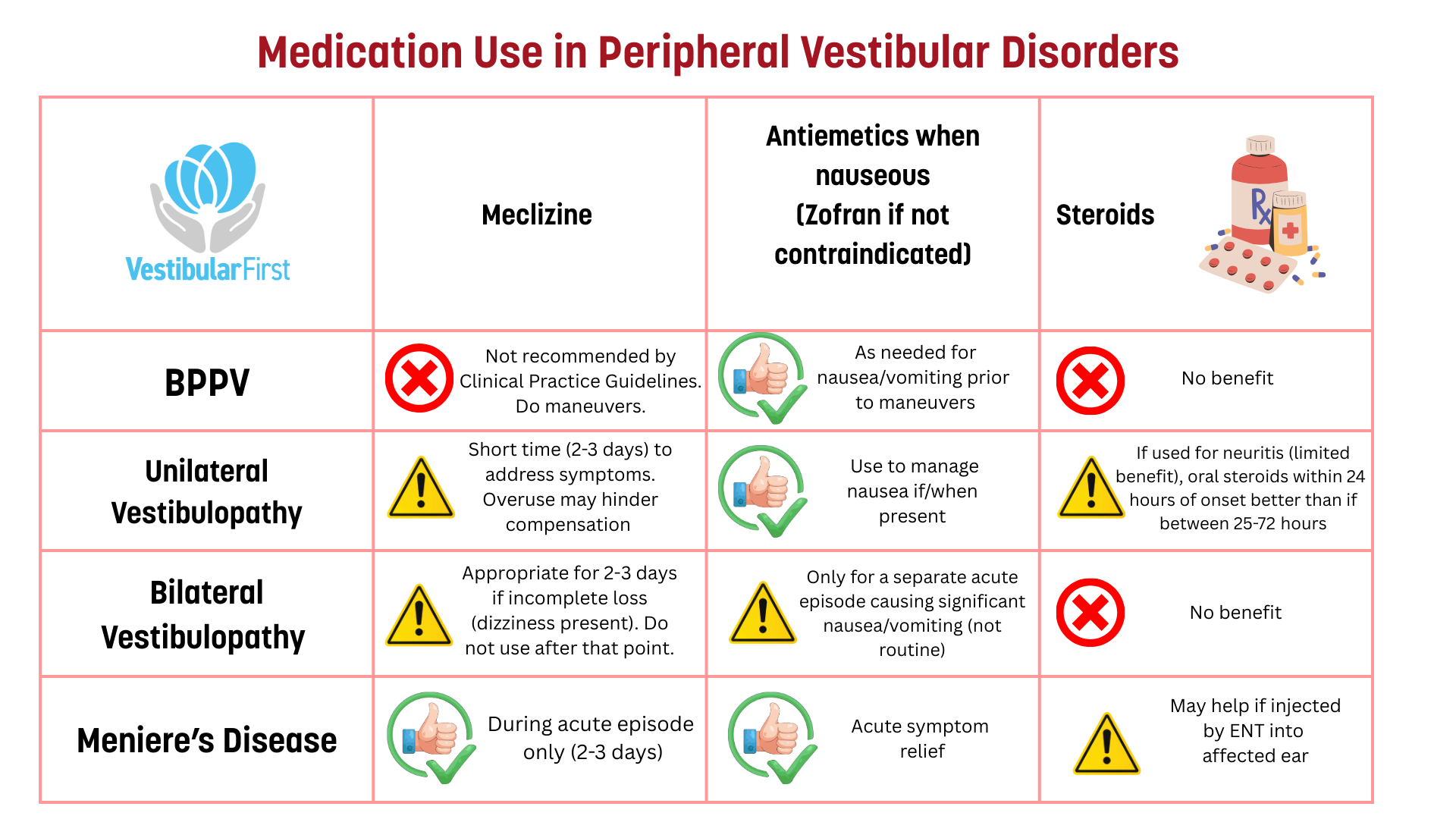
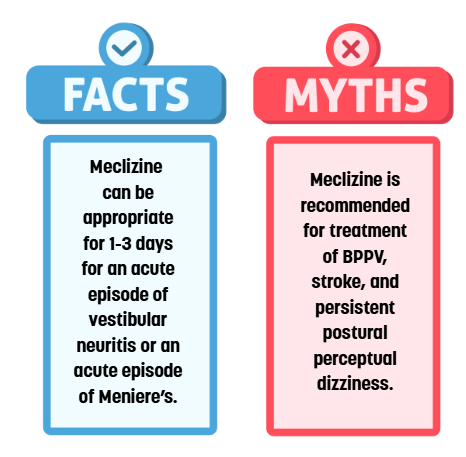
- reduces dizziness in acute (1-3 days) phase of unilateral vestibulopathy (neuritis or Meniere’s episode);
- occasional acute use for dizziness during an episode of vestibular migraine although there are better options.
❌ No benefit:
- not significantly helpful and sometimes harmful with benign paroxysmal positional vertigo (BPPV), stroke, or persistent postural perceptual dizziness (PPPD);
- does not increase speed of vestibular nerve healing after vestibulopathy event.
⚠️ Risks:
- Side effects related to antihistamines (1st generation) (Farzam et al., 2025):
-
Sedation
-
Cognitive impairment
-
Dizziness
-
Tinnitus
-
Delirium (at high doses)
-
Increased risk of falls and cognitive decline in older adults
-
Restricted use in older adults, particularly diphenhydramine
-
QT prolongation (a heart electrical conduction delay, visible on an ECG) and cardiotoxicity in at-risk populations
-
- Side effects related to anticholinergics (Mayo Clinic):
- Confusion
- Blurred vision
- Constipation
- Dry mouth
- Lightheadedness
- Loss of balance
- Trouble urinating
The Great Debate: Steroids after Acute Unilateral Vestibulopathy/ “Vestibular Neuritis”?
Examples: prednisone/prednisolone, methylprednisolone, dexamethasone, hydrocortisone.
🧪What the evidence says:
📈Do steroids improve objective vestibular test recovery?
-
A 2023 review reported that, in a meta-analysis of two randomized controlled trials (50 total patients), corticosteroids (vs placebo) were associated with a higher rate of “complete caloric recovery.” (Oliveira, Naples, Edlow et al., 2023)
-
However, a randomized, placebo-controlled, double-blind trial found that corticosteroid treatment did not significantly improve caloric recovery (and also did not significantly improve vHIT gain recovery) (Sjögren et al., 2025).
Bottom line (objective testing): Results are mixed across studies—some evidence suggests improved caloric test recovery, while a more recent RCT reports no significant improvement.
🌀Do steroids improve how patients feel (symptoms / subjective outcomes)?
-
The 2025 randomized trial reported no significant improvement in subjective well-being with corticosteroids compared with placebo (Sjögren et al., 2025).
- Steroids alone did not improve subjective well-being
-
A 2024 systematic review/meta-analysis focused on early vestibular rehab training reported that early vestibular rehabilitation training combined with corticosteroids was more effective for peripheral acute vestibular syndrome than corticosteroids alone (i.e., the comparison group was steroids alone) (Agger-Nielsen et al., 2024).
- Adding early vestibular rehab training outperformed steroids alone for peripheral acute vestibular syndrome.
Meclizine: Myths That Need Busting!
Other common names: Antivert (prescription), Bonine (Over the Counter)
❌ Myth: “Meclizine should be the go-to treatment for vestibular issues.”
- Step 1: Proper diagnosis – utilize free tools like Dizzy Care Network to determine best next steps for testing and treatment.
- Step 2: Proper referral – audiologists, vestibular rehab specialists, otolaryngologists, and neurologists who specialize in migraine treatment should be on the list of great options.
- Step 3: Proper treatment – for example, BPPV should be treated with appropriate maneuver such as the modified Epley (posterior canal) or Gufoni (horizontal canal).
❌ Myth: “Meclizine should be taken daily for years.”
- Meclizine can be appropriate for an acute episode of dizziness (acute unilateral neuritis, acute Meniere’s episodes, or perhaps vestibular migraine (although there are better choices);
- Patients taking Meclizine daily for years would likely benefit from:
- Gradual weaning off of Meclizine under physician guidance;
- Full vestibular exam by a trained clinician once weaned to establish a clear diagnosis (e.g. persistent postural perceptual dizziness) and then appropriate relevant treatment.
❌ Myth: “Meclizine can be given for dizziness ‘just in case it helps’ since it is so low risk as far as side effects.”
- Meclizine prescribing after dizziness visits was associated with higher injurious falls (in both ≥65 and 18–64 age groups) (Adams et al., 2025; Marmour et al., 2025).
- In older adults, antihistamines/anticholinergics should only be given if benefits outweigh the notable risks of sedation and potential risk of increased cognitive deficits/dementia associated with prolonged use, particularly at higher dosages (AGS Beers Criteria, 2023).
Are There Natural Medications or Vitamins to Treat Dizziness?
🚫 Not recommended: Over-the-counter “dizzy meds”
Products such as Vertisi, Vertigone, DizzyStop, Vertigo Comfort, and Vertigoheel are marketed for dizziness relief but are herbal or homeopathic supplements that are not supported by high-quality clinical evidence at this time.
Because these products are not regulated as medications, their effectiveness, dosing, and safety are uncertain. A documented case report describes acute psychosis following possible ingestion of Vertigoheel, highlighting that risks are not always benign or predictable (O’Connell et al., 2023). For these reasons, over-the-counter “dizzy supplements” should not be used as a substitute for diagnosis-guided care, particularly when symptoms are persistent, recurrent, or unexplained.
✅ Recommended: Nutrition as part of physician-guided care
For patients with certain vestibular disorders, especially vestibular migraine, management often extends beyond short-term symptom suppression and focuses on long-term brain-based prevention strategies.
Patients are encouraged to work with their physicians to ensure adequate nutrition, including attention to:
-
Magnesium
-
Vitamin B2 (riboflavin)
-
Coenzyme Q10 (CoQ10)
-
Vitamin D
-
Omega-3 fatty acids
These nutrients have been studied as part of preventive strategies in migraine and vestibular migraine, where central nervous system excitability and sensory processing play a key role. A 2024 study supports the use of combined magnesium, riboflavin, and CoQ10 supplementation in patients with vestibular migraine as part of a broader management approach (Abu-Zaid et al., 2024).

Medications for Dizziness Related to Central Vestibular Conditions
🧩 Persistent Postural-Perceptual Dizziness (PPPD): medications are adjunctive
PPPD is a chronic functional vestibular disorder characterized by persistent dizziness and unsteadiness with increased sensitivity to motion and visually complex environments (Popkirov et al., 2018).
Current reviews emphasize that:
-
Medications alone are rarely sufficient, because they do not address the learned movement avoidance, visual dependence, or altered sensory weighting seen in PPPD (Staab et al., 2023).
-
Best outcomes are reported with a multimodal approach, typically combining vestibular rehabilitation (to recalibrate sensory processing), psychological/behavioral therapy (to address anxiety and avoidance patterns), and selective use of serotonergic medications (SSRIs/SNRIs) when clinically appropriate (Yagi et al., 2024; Azeez et al., 2025)
-
Evidence suggests that SSRIs combined with vestibular rehabilitation or CBT are associated with greater symptom improvement than any single treatment alone, while acknowledging limitations in study quality (Zheng et al., 2025)
Clinical implication: In PPPD, medications may help lower symptom intensity or anxiety, but meaningful recovery usually requires active retraining of the balance system, not symptom suppression alone.
⚡ Vestibular migraine: migraine-directed therapy, not dizziness medications
Vestibular migraine is a migraine disorder with vestibular manifestations, not a primary inner-ear condition; dizziness and vertigo are thought to arise from migraine-related central nervous system mechanisms affecting vestibular pathways (Silva et al., 2022).
As a result:
-
Vestibular suppressants (e.g., meclizine) are not first-line therapy, as they do not target migraine mechanisms
-
Management typically focuses on migraine-directed abortive and preventive treatments (e.g Propranolol, Calcitonin gene-related peptide (CGRP) inhibitors, Tricyclics), selected based on attack frequency, severity, functional impact, and comorbidities (Choi, 2025; Vasireddy et al., 2025; Almohammed et al., 2025)
Clinical implication: Treatment strategies that target migraine biology and central sensory processing are generally favored over repeated use of nonspecific vestibular suppressants, which may blunt symptoms temporarily but do not reduce migraine susceptibility (Choi, 2025).

🧠 Concussion-related dizziness: symptom-targeted, time-limited medication use
⚠️ Acute central dizziness: rule out stroke before suppressing symptoms
In patients presenting with acute, continuous dizziness or vertigo, posterior circulation stroke must always be considered. Early symptoms can mimic benign vestibular conditions, which may lead to misdiagnosis.
Contemporary emergency care guidelines emphasize:
-
Using timing and trigger patterns, focused eye-movement examination (HINTS), and gait assessment by trained clinicians
-
Avoiding reliance on symptom suppression or routine imaging alone, which can miss early posterior circulation strokes (Edlow et al., 2023)
Clinical implication: Medications may be used briefly to allow hydration or examination, but they should never delay or replace diagnostic evaluation when a central cause is possible (Edlow et al., 2023).
🧠 Multiple sclerosis (MS): rule out peripheral vestibular causes then treat relapses
In MS, dizziness and vertigo may result from central demyelinating lesions affecting vestibular pathways. However, common peripheral conditions—especially BPPV—still occur in MS and must be ruled out to avoid unnecessary corticosteroid treatment or prolonged vestibular suppression (Frohman et al., 2003).
-
If dizziness is part of a true MS relapse, high-dose corticosteroids are often used to speed recovery, though they do not alter long-term disease progression (National MS Society)
-
Short-term symptom medications may be used to support hydration and function
-
Evidence supports combining symptom management with cause-directed evaluation and vestibular rehabilitation, which can improve balance and dizziness in MS (Marsden et al., 2025)
Clinical implication: In MS, determining the cause of dizziness is important prior to prescribing medications.
🧬 CANVAS: no disease-modifying dizziness medication
CANVAS (cerebellar ataxia with neuropathy and vestibular areflexia syndrome) is a progressive neurodegenerative disorder, most commonly associated with biallelic RFC1 repeat expansions. Because the condition reflects degenerative dysfunction of cerebellar, vestibular, and sensory pathways, no medication currently reverses or halts the underlying disease process (Cortese et al., 2020).
-
A published case report demonstrated improved functional outcomes after vestibular rehabilitation, including improvements in gait and functional mobility (Harrell et al., 2023)
Clinical implication: For CANVAS-related dizziness and imbalance, rehabilitation and fall-risk management provide greater benefit than chronic vestibular suppressants.
🎯 Degenerative ataxias: symptom-targeted pharmacology + address eye-movement drivers
In degenerative cerebellar ataxias, treatment focuses on reducing specific symptoms, as disease-modifying options are limited (Perlman, 2024).
Evidence includes:
-
4-aminopyridine reducing attack frequency in episodic ataxia type 2 (Strupp et al., 2011).
-
Riluzole: A 2022 systematic review found that riluzole showed modest improvement in ataxia severity in some hereditary ataxia subtypes, but results were inconsistent across studies, limiting its reliability as a broadly effective treatment (Ayala et al., 2022).
When dizziness is driven by abnormal eye movements (central nystagmus):
-
4-aminopyridine can improve downbeat nystagmus (Claassen et al., 2013)
-
Gabapentin or memantine may reduce oscillopsia and visual blur (Thurtell et al., 2010)
For Friedreich ataxia, omaveloxolone (Skyclarys) is FDA-approved as a disease-specific therapy, though it is not a direct treatment for dizziness (FDA, 2023).
To Learn More – Check out these Resources
- Online, self-paced CEU courses
- NEW Hybrid Intro Vestibular Certification Course:
- Printable resource:
- More Online Learning for diagnosis, treatment and management of common vestibular conditions
- Watch related Journal Clubs:
- Learn more:
- Dr Timothy Hain’s page on Drug Treatment of Vertigo
- University of Utah’s page on Medication Management for Vestibular Migraine
References
- 2023 American Geriatrics Society Beers Criteria: https://health.uconn.edu/pharmacy/wp-content/uploads/sites/60/2023/11/2023-American-Geriatrics-Society-Beers-Criteria-1.pdf?utm_source
- Abu-Zaid A, Abu-Zaid S, Barakat M, Al-Huniti R, Khair H (2024) Effectiveness of combination therapy of magnesium, vitamin B2 and Co-enzyme 10 supplementation on vestibular migraine: a retrospective cohort study. Pharmacia 71: 1–7. https://www.researchgate.net/publication/377923292_Effectiveness_of_combination_therapy_of_magnesium_vitamin_B2_and_Coenzyme_10_supplementation_on_vestibular_migraine_a_retrospective_cohort_study
- Adams ME, Karaca-Mandic P, Marmor S. Meclizine Use and Subsequent Falls Among Patients With Dizziness. JAMA Otolaryngol Head Neck Surg. 2025 Jul 24;151(9):861–7. doi: 10.1001/jamaoto.2025.2052. Epub ahead of print. PMID: 40705353; PMCID: PMC12290902. https://pubmed.ncbi.nlm.nih.gov/40705353/
- Agger-Nielsen HE, Grøndberg TS, Berg-Beckhoff G, Ovesen T. Early vestibular rehabilitation training of peripheral acute vestibular syndrome-a systematic review and meta-analysis. Front Neurol. 2024 May 30;15:1396891. doi: 10.3389/fneur.2024.1396891. PMID: 38872828; PMCID: PMC11169822. https://pubmed.ncbi.nlm.nih.gov/38872828
- Alderson P, Roberts I. Corticosteroids for acute traumatic brain injury. Cochrane Database Syst Rev. 2005 Jan 25;2005(1):CD000196. doi: 10.1002/14651858.CD000196.pub2. PMID: 15674869; PMCID: PMC7043302. https://pmc.ncbi.nlm.nih.gov/articles/PMC7043302/?utm_source
- Almohammed HA, Thalib HI, Kushara KF, Bin Saddiq BW, Al Zoabi BMK, Khan TN, Morad AS, Aljuaid RW, Gharawi LM, Alsaygh SJ, Pereira M, Abuhulayqah S. Prophylactic Management of Vestibular Migraine: A Systematic Review. Ann Clin Transl Neurol. 2025 Dec;12(12):2384-2397. doi: 10.1002/acn3.70234. Epub 2025 Oct 30. PMID: 41166161; PMCID: PMC12698959. https://pmc.ncbi.nlm.nih.gov/articles/PMC12698959/?utm_source
- Ayala IN, Aziz S, Argudo JM, Yepez M, Camacho M, Ojeda D, Aguirre AS, Oña S, Andrade AF, Vasudhar A, Moncayo JA, Hassen G, Ortiz JF, Tambo W. Use of Riluzole for the Treatment of Hereditary Ataxias: A Systematic Review. Brain Sci. 2022 Aug 5;12(8):1040. doi: 10.3390/brainsci12081040. PMID: 36009103; PMCID: PMC9405857. https://pmc.ncbi.nlm.nih.gov/articles/PMC9405857/
- Azeez, S.S., Nada, E.H. Persistent postural-perceptual dizziness: a review of current knowledge on vestibular rehabilitation. Egypt J Otolaryngol 41, 13 (2025). https://doi.org/10.1186/s43163-025-00761-2 https://link.springer.com/article/10.1186/s43163-025-00761-2?utm_source
- Bae CH, Na HG, Choi YS. Current diagnosis and treatment of vestibular neuritis: a narrative review. J Yeungnam Med Sci. 2022 Apr;39(2):81-88. doi: 10.12701/yujm.2021.01228. Epub 2021 Aug 9. PMID: 34411472; PMCID: PMC8913909. https://pmc.ncbi.nlm.nih.gov/articles/PMC8913909/?utm_source
- Bhattacharyya N, Gubbels SP, Schwartz SR, Edlow JA, El-Kashlan H, Fife T, Holmberg JM, Mahoney K, Hollingsworth DB, Roberts R, Seidman MD, Steiner RW, Do BT, Voelker CC, Waguespack RW, Corrigan MD. Clinical Practice Guideline: Benign Paroxysmal Positional Vertigo (Update). Otolaryngol Head Neck Surg. 2017 Mar;156(3_suppl):S1-S47. doi: 10.1177/0194599816689667. PMID: 28248609. https://pubmed.ncbi.nlm.nih.gov/28248609/
- Choi JH, Choi KD, Oh EH, Choi SY. Preventive medical treatment of vestibular migraine: a practical review. Res Vestib Sci. 2025;24(1):20-26. doi: 10.21790/rvs.2024.024 https://e-rvs.org/journal/view.php?number=990
- Chua KW, Huang X, Koh XH, Soh JFJY, Barrera VC, Anaikatti P, Jing D, Moh S, Yeo M, Yuen HW, Low D, Rosario BH. Randomized Controlled Trial Assessing Vitamin D’s Role in Reducing BPPV Recurrence in Older Adults. Otolaryngol Head Neck Surg. 2025 Jan;172(1):127-136. doi: 10.1002/ohn.954. Epub 2024 Aug 28. PMID: 39194424; PMCID: PMC11697526. https://pubmed.ncbi.nlm.nih.gov/39194424/
- Claassen J, Spiegel R, Kalla R, Faldon M, Kennard C, Danchaivijitr C, Bardins S, Rettinger N, Schneider E, Brandt T, Jahn K, Teufel J, Strupp M, Bronstein A. A randomised double-blind, cross-over trial of 4-aminopyridine for downbeat nystagmus–effects on slowphase eye velocity, postural stability, locomotion and symptoms. J Neurol Neurosurg Psychiatry. 2013 Dec;84(12):1392-9. doi: 10.1136/jnnp-2012-304736. Epub 2013 Jun 29. PMID: 23813743. https://pubmed.ncbi.nlm.nih.gov/23813743/
- Cortese A, Tozza S, Yau WY, Rossi S, Beecroft SJ, Jaunmuktane Z, Dyer Z, Ravenscroft G, Lamont PJ, Mossman S, Chancellor A, Maisonobe T, Pereon Y, Cauquil C, Colnaghi S, Mallucci G, Curro R, Tomaselli PJ, Thomas-Black G, Sullivan R, Efthymiou S, Rossor AM, Laurá M, Pipis M, Horga A, Polke J, Kaski D, Horvath R, Chinnery PF, Marques W, Tassorelli C, Devigili G, Leonardis L, Wood NW, Bronstein A, Giunti P, Züchner S, Stojkovic T, Laing N, Roxburgh RH, Houlden H, Reilly MM. Cerebellar ataxia, neuropathy, vestibular areflexia syndrome due to RFC1 repeat expansion. Brain. 2020 Feb 1;143(2):480-490. doi: 10.1093/brain/awz418. PMID: 32040566; PMCID: PMC7009469. https://pubmed.ncbi.nlm.nih.gov/32040566/
- DailyMed: https://dailymed.nlm.nih.gov/dailymed/drugInfo.cfm?audience=consumer&setid=87d4c6d8-9218-48c2-9163-615a32449f11&utm_source
- DailyMed:https://dailymed.nlm.nih.gov/dailymed/drugInfo.cfm?setid=019b93c7-aaa4-b0f8-8ad0-f1bb5f99ad17&utm_source
- DOD Guideline 2024: https://health.mil/Reference-Center/Publications/2024/02/23/Progressive-Return-to-Activity-Primary-Care-for-Acute-Concussion-Management
- Edlow JA, Carpenter C, Akhter M, Khoujah D, Marcolini E, Meurer WJ, Morrill D, Naples JG, Ohle R, Omron R, Sharif S, Siket M, Upadhye S, E Silva LOJ, Sundberg E, Tartt K, Vanni S, Newman-Toker DE, Bellolio F. Guidelines for reasonable and appropriate care in the emergency department 3 (GRACE-3): Acute dizziness and vertigo in the emergency department. Acad Emerg Med. 2023 May;30(5):442-486. doi: 10.1111/acem.14728. PMID: 37166022. https://pubmed.ncbi.nlm.nih.gov/37166022/
- Farzam K, Sabir S, O’Rourke MC. Antihistamines. [Updated 2025 Dec 13]. In: StatPearls [Internet]. Treasure Island (FL): StatPearls Publishing; 2025 Jan-. Available from: https://www.ncbi.nlm.nih.gov/books/NBK538188/?utm_source
- FDA Drug Safety Communication: https://www.fda.gov/drugs/drug-safety-and-availability/fda-drug-safety-communication-new-information-regarding-qt-prolongation-ondansetron-zofran
- Frohman EM, Kramer PD, Dewey RB, Kramer L, Frohman TC. Benign paroxysmal positioning vertigo in multiple sclerosis: diagnosis, pathophysiology and therapeutic techniques. Mult Scler. 2003 Jun;9(3):250-5. doi: 10.1191/1352458503ms901oa. PMID: 12814171. https://pubmed.ncbi.nlm.nih.gov/12814171/
- Gao RX, Zhang XN, Zhu P. Selective serotonin reuptake inhibitors in the treatment of major depressive disorder after brain trauma: Systematic review and meta-analysis. World J Psychiatry. 2025 Mar 19;15(3):100103. doi: 10.5498/wjp.v15.i3.100103. PMID: 40109988; PMCID: PMC11886310. https://pmc.ncbi.nlm.nih.gov/articles/PMC11886310/
- Gianoli GJ. Post-concussive Dizziness: A Review and Clinical Approach to the Patient. Front Neurol. 2022 Jan 4;12:718318. doi: 10.3389/fneur.2021.718318. PMID: 35058868; PMCID: PMC8764304. https://pmc.ncbi.nlm.nih.gov/articles/PMC8764304/
- Harrell RG, Cassidy AR, Klatt BN, Hovareshti P, Whitney SL. Vestibular rehabilitation in cerebellar ataxia with neuropathy and vestibular areflexia syndrome (CANVAS)—a case report. J Otol. 2023;18(4):199–207. doi:10.1016/j.joto.2023.06.004 https://www.sciencedirect.com/science/article/pii/S167229302300048X
- Heslot C, Azouvi P, Perdrieau V, Granger A, Lefèvre-Dognin C, Cogné M. A Systematic Review of Treatments of Post-Concussion Symptoms. J Clin Med. 2022 Oct 21;11(20):6224. doi: 10.3390/jcm11206224. PMID: 36294545; PMCID: PMC9604759. https://pubmed.ncbi.nlm.nih.gov/36294545/
- Houston BT, Patel P, Chowdhury YS. Meclizine. [Updated 2024 Feb 28]. In: StatPearls [Internet]. Treasure Island (FL): StatPearls Publishing; 2025 Jan-. Available from: https://www.ncbi.nlm.nih.gov/books/NBK560645/?utm_source
- Jeong SH, Lee SU, Kim JS. Prevention of recurrent benign paroxysmal positional vertigo with vitamin D supplementation: a meta-analysis. J Neurol. 2022 Feb;269(2):619-626. doi: 10.1007/s00415-020-09952-8. Epub 2020 Aug 7. PMID: 32767116. https://pubmed.ncbi.nlm.nih.gov/32767116/
- Lucke-Wold B, Zasler ND, Ruchika F, et al. Supplement and nutraceutical therapy in traumatic brain injury. Nutritional Neuroscience. 2024;28(5):1-35. doi:10.1080/1028415X.2024.2404782. https://www.researchgate.net/publication/387555056_Supplement_and_nutraceutical_therapy_in_traumatic_brain_injury
- Marmor S, Karaca-Mandic P, Adams ME. Vestibular Suppressant Utilization and Subsequent Falls Among Patients 65 Years and Older With Dizziness in the United States. J Am Geriatr Soc. 2025 May;73(5):1398-1405. doi: 10.1111/jgs.19377. Epub 2025 Feb 4. PMID: 39902815; PMCID: PMC12100683. https://pmc.ncbi.nlm.nih.gov/articles/PMC12100683/?utm_source
- Marsden J, Dennett R, Gibbon A, Knight Lozano R, Freeman JA, Bamiou DE, Harris C, Hawton A, Goodwin E, Creanor S, Sorrell L, Hoskings J, Pavlou M. Vestibular Rehabilitation in Multiple Sclerosis: Randomized Controlled Trial and Cost-Effectiveness Analysis Comparing Customized With Booklet Based Vestibular Rehabilitation for Vestibulopathy. Neurorehabil Neural Repair. 2025 Sep;39(9):687-700. doi: 10.1177/15459683251345444. Epub 2025 Jun 17. PMID: 40528281; PMCID: PMC12405695. https://pubmed.ncbi.nlm.nih.gov/40528281/
- Mayo Clinic: https://www.mayoclinic.org/healthy-lifestyle/healthy-aging/in-depth/medications-older-adults/art-20572714?utm_source
- Mullally WJ. Concussion. Am J Med. 2017 Aug;130(8):885-892. doi: 10.1016/j.amjmed.2017.04.016. Epub 2017 May 11. PMID: 28502817. https://www.amjmed.com/article/S0002-9343(17)30482-5/pdf
- Moore S, Musgrave C, Sandler J, Bradley B, Jones JRA. Early intervention treatment in the first 2 weeks following concussion in adults: A systematic review of randomised controlled trials. Phys Ther Sport. 2024 Jan;65:59-73. doi: 10.1016/j.ptsp.2023.11.005. Epub 2023 Dec 3. PMID: 38065015. https://pubmed.ncbi.nlm.nih.gov/38065015/
- National MS Society: https://www.nationalmssociety.org/article/medications-for-acute-exacerbations
- Newman-Toker DE, Camargo CA Jr, Hsieh YH, Pelletier AJ, Edlow JA. Disconnect between charted vestibular diagnoses and emergency department management decisions: a cross-sectional analysis from a nationally representative sample. Acad Emerg Med. 2009 Oct;16(10):970-7. doi: 10.1111/j.1553-2712.2009.00523.x. PMID: 19799573. https://pubmed.ncbi.nlm.nih.gov/19799573/
- O’Connell M, Hunt E, VandenBerg A. Vertigoheel induced psychosis: A patient case report. Ment Health Clin. 2021 Jan 8;11(1):31-34. doi: 10.9740/mhc.2021.01.031. PMID: 33505824; PMCID: PMC7800325. https://pubmed.ncbi.nlm.nih.gov/33505824/
- Oliveira J. e Silva, L., Khoujah, D., Naples, J. G., Edlow, J. A., Gerberi, D. J., Carpenter, C. R., & Bellolio, F. (2023). Corticosteroids for patients with vestibular neuritis: An evidence synthesis for guidelines for reasonable and appropriate care in the emergency department. Academic Emergency Medicine, 30(5), 531-540. https://doi.org/10.1111/acem.14583
- Perlman SL. CRPD frontiers in movement disorders Therapeutics: From evidence to treatment and applications: Addressing Patients’ Needs in the Management of the Ataxias. Clin Parkinson Relat Disord. 2024;10:100255. doi:10.1016/j.prdoa.2024.100255. https://www.sciencedirect.com/science/article/pii/S2590112524000264
- Popkirov S, Staab JP, Stone J. Persistent postural-perceptual dizziness (PPPD): a common, characteristic and treatable cause of chronic dizziness. Pract Neurol. 2018 Feb;18(1):5-13. doi: 10.1136/practneurol-2017-001809. Epub 2017 Dec 5. PMID: 29208729. https://pubmed.ncbi.nlm.nih.gov/29208729/
- Scarff JR, Lippmann S. Treating Psychiatric Symptoms in Persistent Postural Perceptual Dizziness. Innov Clin Neurosci. 2023 Dec 1;20(10-12):49-54. PMID: 38193106; PMCID: PMC10773599. https://pmc.ncbi.nlm.nih.gov/articles/PMC10773599/?utm_source
- Scorza KA, Cole W. Current Concepts in Concussion: Initial Evaluation and Management. Am Fam Physician. 2019 Apr 1;99(7):426-434. PMID: 30932451. https://pubmed.ncbi.nlm.nih.gov/30932451/
- Sjögren J, Fransson PA, Magnusson M, Karlberg M, Tjernström F. Acute unilateral vestibulopathy and corticosteroid treatment – A randomized placebo-controlled double-blind trial. J Vestib Res. 2025 Mar;35(2):91-101. doi: 10.1177/09574271241307649. Epub 2024 Dec 18. PMID: 39973595; PMCID: PMC12231810. https://pubmed.ncbi.nlm.nih.gov/39973595/
- Silva VPR, Castro LHM, Calderaro M. Vestibular migraine. Arq Neuropsiquiatr. 2022 May;80(5 Suppl 1):232-237. doi: 10.1590/0004-282X-ANP-2022-S111. PMID: 35976301; PMCID: PMC9491429. https://pubmed.ncbi.nlm.nih.gov/35976301/
- Staab JP. Persistent Postural-Perceptual Dizziness: Review and Update on Key Mechanisms of the Most Common Functional Neuro-otologic Disorder. Neurol Clin. 2023;41(3):647-664. doi:10.1016/j.ncl.2023.04.003. https://www.binasss.sa.cr/bibliotecas/bhm/nov23/39.pdf
- Strupp M, Kalla R, Claassen J, Adrion C, Mansmann U, Klopstock T, Freilinger T, Neugebauer H, Spiegel R, Dichgans M, Lehmann-Horn F, Jurkat-Rott K, Brandt T, Jen JC, Jahn K. A randomized trial of 4-aminopyridine in EA2 and related familial episodic ataxias. Neurology. 2011 Jul 19;77(3):269-75. doi: 10.1212/WNL.0b013e318225ab07. Epub 2011 Jul 6. PMID: 21734179; PMCID: PMC3136055. https://pubmed.ncbi.nlm.nih.gov/21734179/
- TBI Guidelines 2024: https://idhi.uams.edu/brain-injury-program/wp-content/uploads/sites/9/2024/12/Guidelines-TBI-Dizziness-and-Balance-2024.pdf
- Tepper SJ, Tepper K. Nutraceuticals and Headache 2024: Riboflavin, Coenzyme Q10, Feverfew, Magnesium, Melatonin, and Butterbur. Curr Pain Headache Rep. 2025 Jan 24;29(1):33. doi: 10.1007/s11916-025-01358-3. PMID: 39853578. https://pubmed.ncbi.nlm.nih.gov/39853578/
- Thurtell MJ, Joshi AC, Leone AC, Tomsak RL, Kosmorsky GS, Stahl JS, Leigh RJ. Crossover trial of gabapentin and memantine as treatment for acquired nystagmus. Ann Neurol. 2010 May;67(5):676-80. doi: 10.1002/ana.21991. PMID: 20437565; PMCID: PMC3064518. https://pubmed.ncbi.nlm.nih.gov/20437565/
- Vasireddy S, Biswas S, Kollu R, Krishnan E, Khan MS, C F, Jayakumar A, Acharya R. Comparative effectiveness and safety of preventive treatments for vestibular migraine: a systematic review and network meta-analysis. BMC Neurol. 2025 Dec 30;25(1):513. doi: 10.1186/s12883-025-04490-0. PMID: 41469852; PMCID: PMC12754936. https://pmc.ncbi.nlm.nih.gov/articles/PMC12754936/
- Viola P, Gioacchini FM, Astorina A, Pisani D, Scarpa A, Marcianò G, Casarella A, Basile E, Rania V, Re M, Chiarella G. The pharmacological treatment of acute vestibular syndrome. Front Neurol. 2022 Sep 9;13:999112. doi: 10.3389/fneur.2022.999112. PMID: 36158968; PMCID: PMC9500199. https://pubmed.ncbi.nlm.nih.gov/36158968/
- Wang Y, Huang L, Li J, Duan J, Pan X, Menon BK, Anderson CS, Liu M, Wu S. Efficacy and safety of corticosteroids for stroke and traumatic brain injury: a systematic review and meta-analysis. Syst Rev. 2025 Mar 4;14(1):54. doi: 10.1186/s13643-025-02803-5. PMID: 40038828; PMCID: PMC11877790. https://pubmed.ncbi.nlm.nih.gov/40038828/
- Yagi C, Kimura A, Horii A. Persistent postural-perceptual dizziness: A functional neuro-otologic disorder. Auris Nasus Larynx. 2024 Jun;51(3):588-598. doi: 10.1016/j.anl.2023.12.008. Epub 2024 Mar 29. PMID: 38552422. https://pubmed.ncbi.nlm.nih.gov/38552422/
- Zheng Y, Guo Z, Liu X, Chen H, Gang W, Chen H, Wang W. Effect of conservative therapy for persistent postural-perceptual dizziness: a systematic review and meta-analysis. Front Psychiatry. 2025 Oct 30;16:1676218. doi: 10.3389/fpsyt.2025.1676218. PMID: 41244873; PMCID: PMC12612630. https://pmc.ncbi.nlm.nih.gov/articles/PMC12612630/?utm_source