
Modified Zuma Maneuver
Description
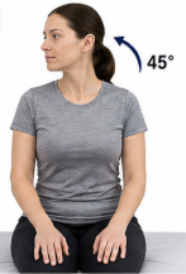
The Modified Zuma Maneuver is a repositioning technique for horizontal canalithiasis BPPV. It begins with the head turned 45° toward the unaffected side, followed by movements from the affected side toward the unaffected side and a slight forward head tilt before returning to sitting.
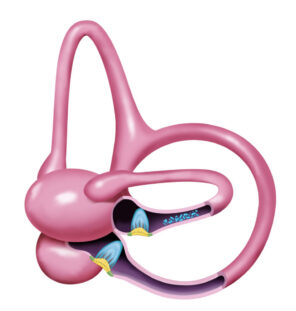
Unlike the standard Zuma maneuver, which was developed for horizontal cupulolithiasis BPPV, the modification is designed to move the otoconia continuously toward the utricle and avoid initially moving them away from it (Zuma e Maia et al., 2020; Ramos et al., 2021).
Effectiveness
In the initial case series, all 7 patients had resolution of positional vertigo and nystagmus one hour after a single Modified Zuma Maneuver, giving an immediate success rate of 100% (Ramos et al., 2021). However, the study had a very small sample, no comparison group, and no long-term follow-up, so larger controlled studies are needed to confirm its effectiveness.
History
The treatment was developed by Dr. Francisco Zuma e Maia and colleagues as an extension of the original technique. The modified protocol was described in 2020, followed by publication of its initial clinical evaluation in 2021 (Zuma e Maia et al., 2020; Ramos et al., 2021).

Instructions
The purpose is to treat geotropic horizontal-canal BPPV and resolve the associated positional vertigo and nystagmus. The article does not prescribe a specific holding time and states that the three-minute holds used in the original Zuma maneuver are unnecessary for this modification (Ramos et al., 2021).
Right
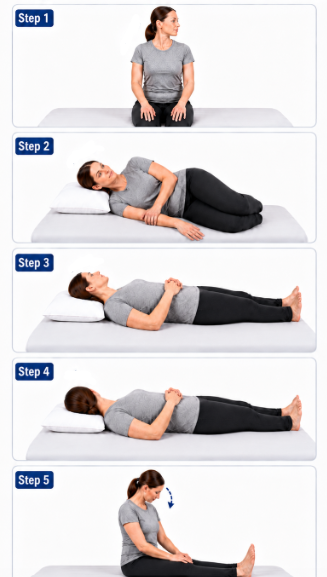
- Begin with the patient sitting upright. Turn the head 45° to the left, away from the affected ear.
- Maintaining the head position, move the patient into right side-lying.
- Move the patient into a supine position, with the head in neutral.
- Turn the head 90° to the left, toward the unaffected side.
- Tilt the head slightly forward, then slowly return the patient to sitting.
Left
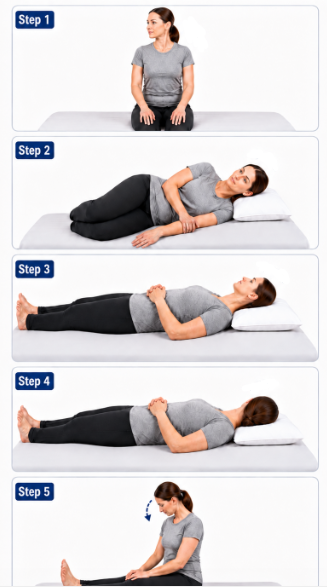
- Begin with the patient sitting upright. Turn the head 45° to the right, away from the affected ear.
- Maintaining the head position, move the patient into left side-lying.
- Move the patient into a supine position, with the head in neutral.
- Turn the head 90° to the right, toward the unaffected side.
- Tilt the head slightly forward, then slowly return the patient to sitting.
RIGHT
LEFT
Related Pathology
Sources
- Bhandari A, Bhandari R, Kingma H, Zuma e Maia F, Strupp M. Three-dimensional simulations of six treatment maneuvers for horizontal canal benign paroxysmal positional vertigo canalithiasis. Eur J Neurol. 2021;28(12):4178-4183. doi:10.1111/ene.15044
- Ramos BF, Cal R, Brock CM, Mangabeira Albernaz PL, Zuma e Maia F. Zuma modified maneuver as a treatment to geotropic lateral semicircular canal benign paroxysmal positional vertigo. Int Arch Otorhinolaryngol. 2021;25(2):e255-e257. doi:10.1055/s-0040-1712935
- Zuma e Maia F, Ramos BF, Cal R, Brock CM, Mangabeira Albernaz PL, Strupp M. Management of lateral semicircular canal benign paroxysmal positional vertigo. Front Neurol. 2020;11:1040. doi:10.3389/fneur.2020.01040