
Modified Yacovino Maneuver

Description
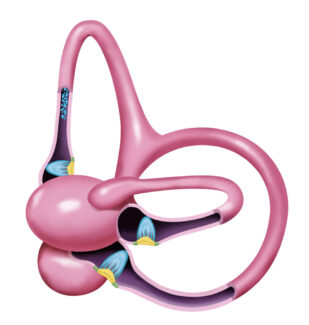
The modified Yacovino maneuver, also called the deep head-hanging maneuver, is a canalith repositioning procedure designed for treating anterior (superior) canal benign paroxsymal positional vertigo (BPPV). Unlike other maneuvers, it does not require identifying which side is affected, since both anterior canals are oriented in the sagittal plane. It can be performed immediately after the straight head hanging test, allowing the clinician to move directly from testing into treatment without needing to reposition the patient. By using gravity through a controlled sequence of head and body movements, the maneuver helps guide dislodged otoconia out of the anterior canal and back into the utricle.
Effectiveness
The standard Yacovino maneuver has a reported effectiveness of approximately 78.8% in systematic review data (Anagnostou et al., 2015). Clinical evidence supports this approach: in a series of 40 patients, the maneuver resolved symptoms effectively in anterior canalithiasis (13 patients cured after one treatment; 21 after one week) (Yang et al., 2019). Prospective data from 28 patients further demonstrated high success rates, with 82.1% cleared after one session, another 14.2% cleared after two sessions, and 100% resolution within three sessions (Al Saif et al., 2012).
However, biomechanical simulations have shown that the classic Yacovino maneuver carries a risk of conversion into the posterior canal (Bhandari et al., 2021). To address this, the modified Yacovino has been suggested in which the patient transitions from supine with at least 30° cervical extension in the midline directly to upright sitting—skipping the chin-to-chest step. More recent computational fluid dynamics modeling confirmed concerns with the original version, showing risks of otoconia trapping and canal switch, while optimized angle modifications and stepwise rests enhanced clearance toward the utricle and reduced conversion risk (Arán-Tapia et al., 2025). There are no studies to date showing the effectiveness of the modified Yacovino.
History

Dr. Dario Andres Yacovino

Dr. Timothy Hain
The maneuver was first introduced in 2009 by Dr. Dario Andres Yacovino with colleagues Dr. Timothy Hain and Dr. Francisco Gualtieri. At the time, anterior canal BPPV was considered rare and difficult to diagnose, often confused with central causes of downbeat nystagmus. Existing treatments adapted from posterior canal maneuvers (like Epley or Semont) required knowing which side was involved, which was not always possible in anterior canal cases. This innovation simplified treatment and became a reference point for managing anterior canal BPPV.
Instructions
The purpose of the treatment is to reposition displaced otoconia from the anterior canal into the utricle, thereby resolving the abnormal canal stimulation responsible for vertigo/dizziness and positional nystagmus.
- Explain the procedure to the patient and obtain consent.
- Start seated in a long sitting position, head in midline.
- Assist the patient into supine and move their head into 30 deg of extension. Hold this position for 30 sec.
- Return to an upright seated position. Hold this position 30 seconds.
- Then flex the neck forward 45 deg and hold for 30 sec.
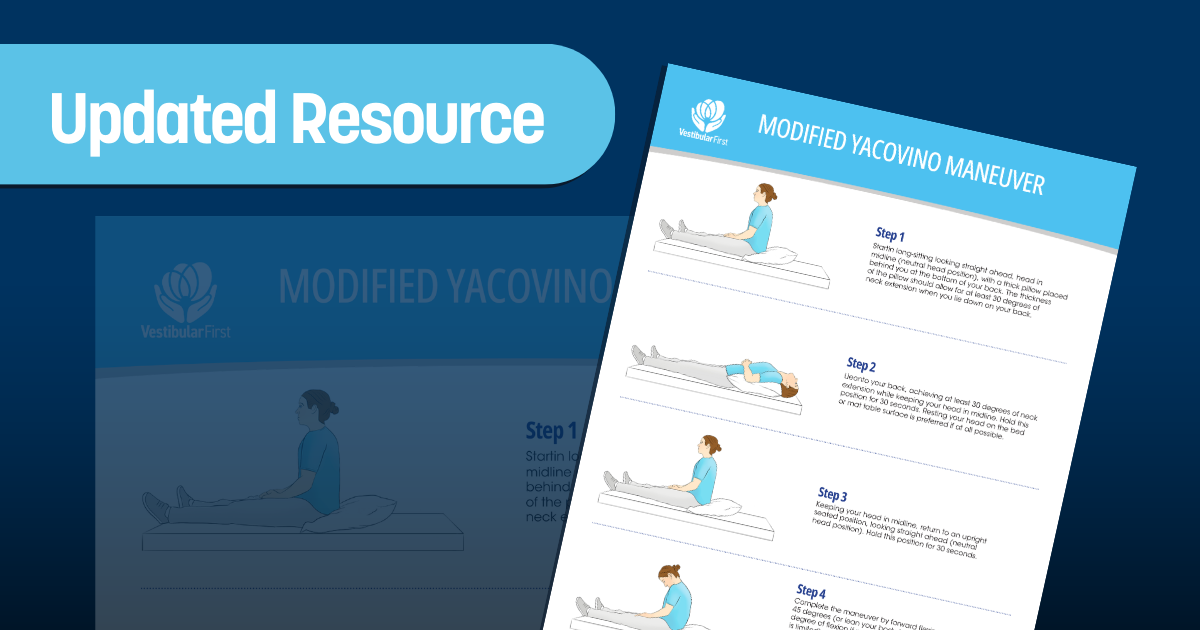
Patient Focused Handout (PDF)
Looking for a patient-friendly handout for an at-home maneuver? We created a free printable resource you can give to your patients. Download it today!
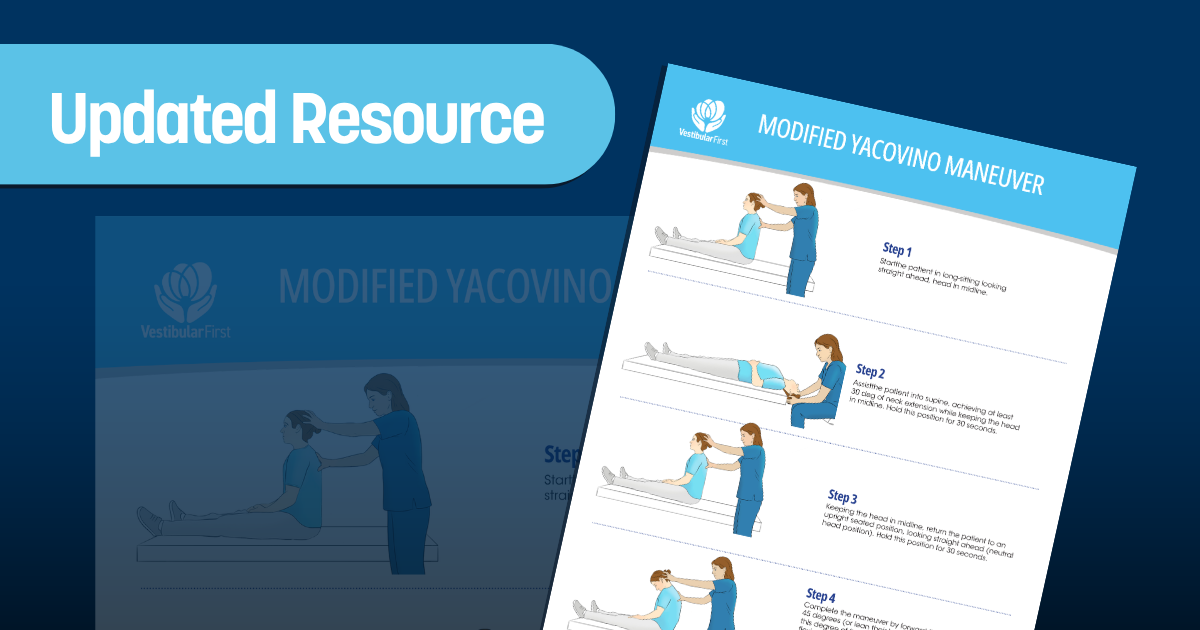
Clinician Focused Handout (PDF)
Looking for a clinician handout for step by step instructions and images? We created a free printable resource you can utilize. Download it today!
Related Pathology
Sources
- Al Saif AA, Al Senany S. Physical therapy management of anterior canal benign paroxysmal positional vertigo by the deep head hanging maneuver. International Journal of Health Sciences. 2012;2(4):29-32. doi:10.5923/j.health.20120204.02. https://www.researchgate.net/publication/313899724_Physical_therapy_management_of_Anterior_Canal_Benign_Paroxysmal_Positional_Vertigo_by_the_Deep_Head_Hanging_Maneuver
- Anagnostou E, Kouzi I, Spengos K. Diagnosis and Treatment of Anterior-Canal Benign Paroxysmal Positional Vertigo: A Systematic Review. J Clin Neurol. 2015 Jul;11(3):262-7. doi: 10.3988/jcn.2015.11.3.262. Epub 2015 May 28. PMID: 26022461; PMCID: PMC4507381. https://pubmed.ncbi.nlm.nih.gov/26022461/
- Bhandari A, Bhandari R, Kingma H, Strupp M. Diagnostic and Therapeutic Maneuvers for Anterior Canal BPPV Canalithiasis: Three-Dimensional Simulations. Front Neurol. 2021 Sep 24;12:740599. doi: 10.3389/fneur.2021.740599. PMID: 34630309; PMCID: PMC8497794. https://pubmed.ncbi.nlm.nih.gov/34630309/
- Bhattacharyya N, Gubbels SP, Schwartz SR, Edlow JA, El-Kashlan H, Fife T, Holmberg JM, Mahoney K, Hollingsworth DB, Roberts R, Seidman MD, Steiner RW, Do BT, Voelker CC, Waguespack RW, Corrigan MD. Clinical Practice Guideline: Benign Paroxysmal Positional Vertigo (Update). Otolaryngol Head Neck Surg. 2017 Mar;156(3_suppl):S1-S47. doi: 10.1177/0194599816689667. PMID: 28248609. https://pubmed.ncbi.nlm.nih.gov/28248609/
- Wu Y, Song N, Ling X, Li X, Feng Y, Xing Y, Gu P, Yang X. Canal switch in benign paroxysmal positional vertigo: Clinical characteristics and possible mechanisms. Front Neurol. 2022 Nov 14;13:1049828. doi: 10.3389/fneur.2022.1049828. PMID: 36452167; PMCID: PMC9702335. https://pubmed.ncbi.nlm.nih.gov/36452167/
- Yacovino DA, Hain TC, Gualtieri F. New therapeutic maneuver for anterior canal benign paroxysmal positional vertigo. J Neurol. 2009 Nov;256(11):1851-5. doi: 10.1007/s00415-009-5208-1. Epub 2009 Jun 18. PMID: 19536580. https://pubmed.ncbi.nlm.nih.gov/19536580/
- Yang X, Ling X, Shen B, Hong Y, Li K, Si L, Kim JS. Diagnosis strategy and Yacovino maneuver for anterior canal-benign paroxysmal positional vertigo. J Neurol. 2019 Jul;266(7):1674-1684. doi: 10.1007/s00415-019-09312-1. Epub 2019 Apr 8. PMID: 30963252. https://pubmed.ncbi.nlm.nih.gov/26022461/