
Sleep Maneuver for Posterior Canal
Description

Effectiveness
The treatment has shown moderate effectiveness for posterior canal BPPV when performed once daily, with reported resolution in 66.7% of cases after 1 week and 88.9% after 2 weeks (Shih and Wang, 2013). It may also be useful as a home follow-up after in-clinic canalith repositioning, with one study finding fewer repeat treatments and shorter symptom duration when the Sleep Maneuver was added to standard repositioning care (Lee et al., 2021).
History
The maneuver first appeared in the literature under the more technical name supine-to-prolonged-lateral-position maneuver. The term “Sleep Maneuver” reflects how it is commonly used in practice: as a bedtime positioning strategy rather than a traditional in-clinic repositioning sequence. Shih and Wang introduced the maneuver in 2013, and later research by Lee et al. helped define its role as a follow-up option after standard canalith repositioning care (Shih and Wang, 2013; Lee et al., 2021).
Instructions
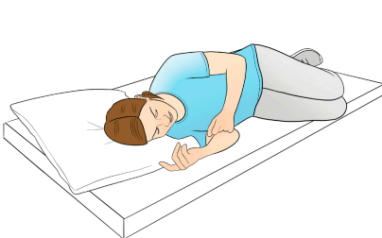
The purpose of the Sleep Maneuver is to provide a simple home-based option for posterior canal BPPV after the affected side has been identified. It is intended to help move loose otoconia out of the posterior canal using prolonged side-lying positioning.
Right
- Start sitting upright in bed with your head centered.
- Lie flat on your back with your head supported on a pillow and centered. Wait until dizziness stops, then wait 3 more minutes.
- Roll onto your left side, keeping your head and neck neutral and supported by the pillow. Stay there for at least 30 minutes, or sleep in this position if you can.
Left
- Start sitting upright in bed with your head centered.
- Lie flat on your back with your head supported on a pillow and centered. Wait until dizziness stops, then wait 3 more minutes.
- Roll onto your right side, keeping your head and neck neutral and supported by the pillow. Stay there for at least 30 minutes, or sleep in this position if you can.
Patient Focused Handouts (PDFs)
Looking for a patient-friendly handout for an at-home maneuver? We created a free printable resource you can give to your patients. Download it today!

Related Pathology
Sources
- Lee CJ, Lee CY, Wu PH, Wang CH, Chen HC, Shih CP. Efficacy of combined canalith-repositioning procedure and supine to prolonged lateral position in treating posterior canal benign paroxysmal positional vertigo. Auris Nasus Larynx. 2021;48(5):834-840. doi:10.1016/j.anl.2021.01.009. https://www.sciencedirect.com/science/article/abs/pii/S0385814621000274
- Shih CP, Wang CH. Supine to prolonged lateral position: a novel therapeutic maneuver for posterior canal benign paroxysmal positional vertigo. J Neurol. 2013;260(5):1375-1381. doi:10.1007/s00415-012-6807-9. https://pubmed.ncbi.nlm.nih.gov/23266893/