
Bascule Maneuver
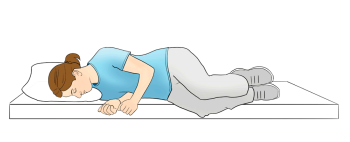
Description
Effectiveness
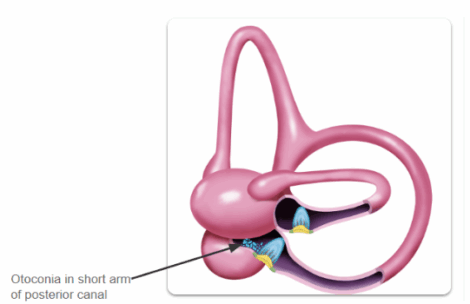
In a 15-patient series the Bascule maneuver alone resolved symptoms in 1 patient (6.7%), while mastoid oscillation and the Bascule maneuver resolved symptoms in 10 patients (66.7%), together accounting for 73.4% of cases (Castellucci et al., 2025). In a separate case report, it successfully converted short-arm posterior canal BPPV into a typical long-arm form, which then resolved with Epley maneuvers.
History
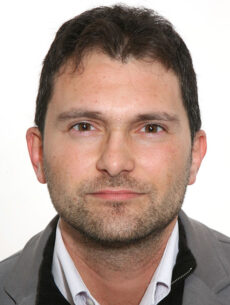
Dr. Andrea Castellucci
Dr. Castellucci is an otoneurologist and ENT surgeon at AUSL–IRCCS Reggio Emilia (Italy), a board member of VIS (Italian Society of Vestibular Disease), and a member of the Bárány Society.
The name “bascule” comes from French and refers to a counter-balanced, seesaw-like mechanism—famously used in bascule bridges—capturing the maneuver’s use of brisk, balanced head–torso motions to leverage inertia and gravity for otolith repositioning. Developed by Dr. Castellucci and colleagues in Italy, the Bascule maneuver entered the peer-reviewed literature in 2025.
Instructions
The purpose is to generate inertial forces that free otoconia adherent to the posterior cupula or trapped near the common crus/short arm and drive them toward the utricle—often converting atypical posterior canal BPPV into a typical, more easily treated form.
Right Ear
- Explain the procedure to the patient and obtain consent.
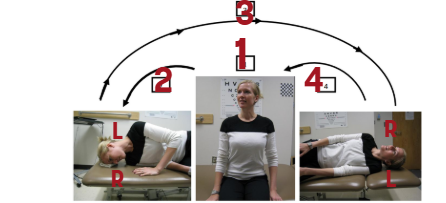
- Start seated on the edge of the table or bed, rotate the head 45 deg towards the left side.
- Quickly move into sidelying on the left, maintaining head rotation to the left with nose down. Hold 15-30 sec.
- Rapidly rotate the head and torso together 180° to lie on the right side with the nose up. Hold 15-30 sec.
- Quickly rotate 180° back to the left side to finish nose-down. Hold 15-30 sec.
- Can perform up to a total of five such sequences on each side (right and left).
Left Ear
- Explain the procedure to the patient and obtain consent.
- Start seated on the edge of the table or bed, rotate the head 45 deg towards the right side.
- Quickly move into sidelying on the right side, maintaining head rotation to the right with nose down. Hold 15-30 sec.
- Rapidly rotate the head and torso together 180° to lie on the left side with the nose up. Hold 15-30 sec.
- Quickly rotate 180° back to the right side to finish nose-down. Hold 15-30 sec
- Can perform up to a total of five such sequences on each side (right and left).
Related Pathology
Check out our Journal Club on Minimum Stimulus BPPV Testing with Dr. Andrea Castellucci
Sources
- Castellucci, Andrea; Mohamad, Alfarghal; Vats, Ajay Kumar; Kothari, Sudhir; Vats, Shreya; Bijlani, Avinash. Physical therapy for posterior semicircular cupulolithiasis: A case series of 15 patients from South Rajasthan. Hearing Balance and Communication 23(2):p 92-98, Apr–Jun 2025. | DOI: 10.4103/HBC.HBC_11_25 https://journals.lww.com/hbcm/fulltext/2025/04000/physical_therapy_for_posterior_semicircular.7.aspx
- Castellucci A, Vats AK, Kothari S, Vats S, Rohiwal R. Atypical to Typical Posterior Semicircular Canal Benign Paroxysmal Positional Vertigo (BPPV): Bascule Maneuver in Short-Arm Posterior Canal BPPV. Ann Otol Neurotol. 2025;6:e019. doi: 10.25259/AONO_10_2025 https://aonojournal.com/atypical-to-typical-posterior-semicircular-canal-benign-paroxysmal-positional-vertigo-bppv-bascule-maneuver-in-short-arm-posterior-canal-bppv/